Sunday, November 8, 2009

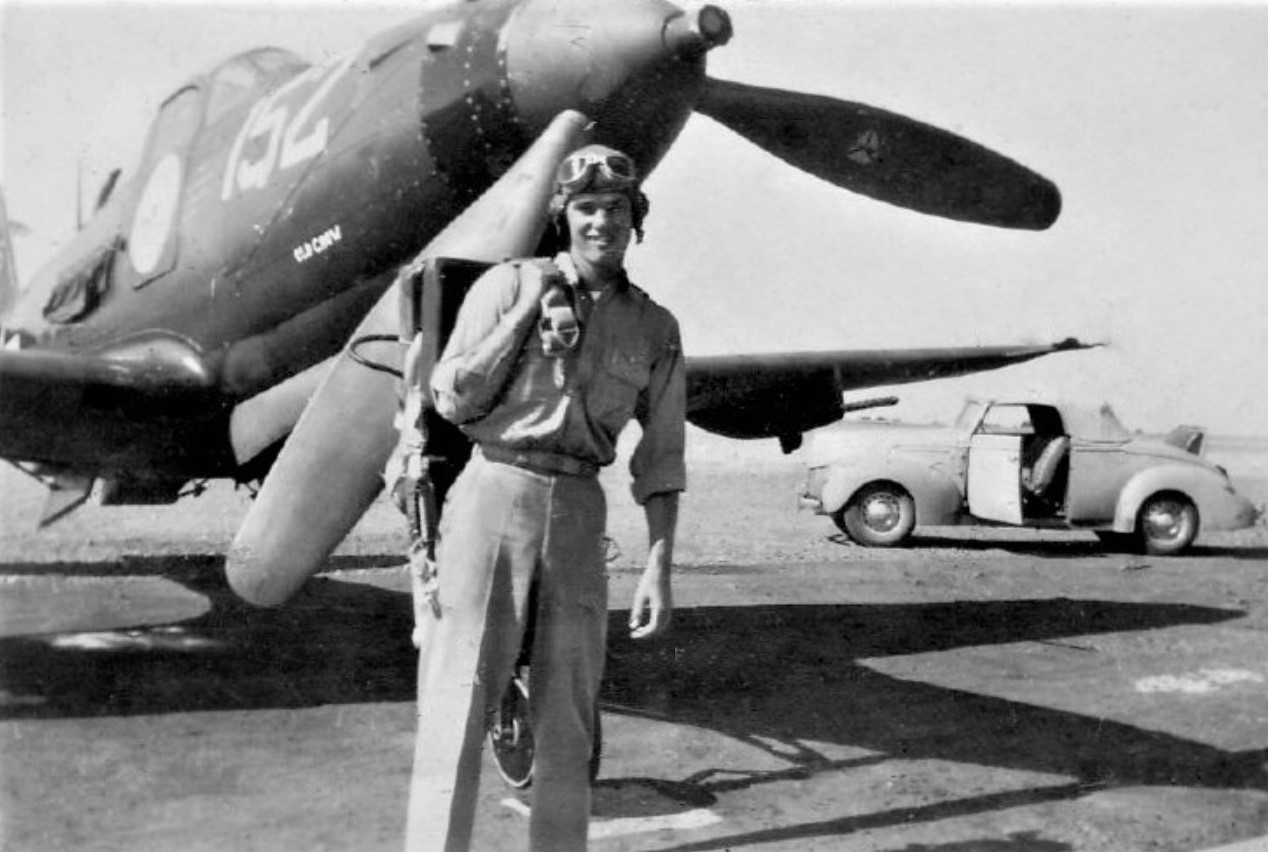
Profile 37: "Dolph's Devil"

Five, six years ago, a buddy asked me if I had any interest in the Korean War and if so, would I think about ever "...drawing (a particular airplane) of that era?" At the time, I wasn't.

For me, there's value in learning of the noble traits of sacrifice, focused creativity and belief in an Ideal. That's why I can so easily call the ordinary service of the WW2 generation, "Heroic."

But Korea? That was the war that pulled the WW2 guys away from their young families. That was the war that taught me that politicians can determine targets. Yeah, I'm generalizing, but the first taste I had of the Korean Conflict was watching "The Bridges at Toko Ri" on late night TV. A fantastic film, but it left me - even at age ten or so - with a kind of emotional heartburn. The movie ends with the quote of grizzled Admiral asking the audience, "Where do we get such men?" Like I wrote, Korea is the war that pulled the WW2 guys away from...

My understanding is that the Korean Conflict was not about the disease - (Communism) - but about the spread of the disease. That doesn't quite make sense. Patton may have been crazy, but he may have been as a fox when he stated that the Allied world should plow through Russia and met MacArthur in Japan.

Would Korea have happened? The Eastern Bloc? Vietnam? Or did the Yin/Yang of Capitalism & Communism somehow stabilize the world?

Bah. I'm wasting time on a non-issue. But suffice it to say, in the past few years, I've learned that though I don't understand the politics, the same wonderful traits of character were all the more apparent in the heroes of 1950-1953.*

And so, thanks to Morton, I am starting on the machine of a particularly heroic pilot named Dolph Overton. You'll like this one.

*Even now, the "Korean War" isn't officially over.


Tuesday, October 6, 2009

Profile 36 - YO-YO as flown by Senator George McGovern

Presenting "YO-YO" - a B-24J Liberator as it flew with the 741st Bomber Squadron, 455th Bomber Group, 15th Air Force, Italy, circa 1944.

Some historians have recorded George flying a B-24 named "Dakota Queen." No photographic reference exists of that airplane. However, George's logs show that he flew "YO-YO" in combat and being that ample photographic documentation remains of this airplane, I went with what could be verified.

I hope to soon get the Senator's blessing on the artwork, but I'm confident enough that YO-YO is on-target, so I'm posting it now.

Anyway, I believe that in WW2, unique cultures emerged within each aerial discipline. Whether by nature or nurture, I can't quite tell, but suffice it to say, fighter pilots tend to act like fighter pilots, bomber pilots like bomber pilots, recon pilots like recon pilots...My explanation is that the man had to fit the mission.

A fair number of history buffs read this blog so the following may be old-hat. Nevertheless, the job of a WW2 bomber pilot was governed by a strong value system. Teamwork, consistency and single-mindedness were absolutely necessary for their mission. Strength was in numbers, security in discipline and success by collectively doing the job so well, it needn't be done again.

Today, there is no proper analog to the job George did. The image of the bomber pilot, working to hold his clumsy machine in formation, trundling through clouds of supersonic shrapnel* and parenting a crew of eight, ten men is forever locked in the 1940s.

Thankfully, the inspiration of such dedication and focus is timeless. Without a doubt, George's sense of public service and passion for the rights of others was honed in that cockpit. I remember that during the 1972 presidential election, George took more flak for his aggressive opposition to the Vietnam War, Though history has vindicated his position, I wonder if back then people really understood that he
knew what he was talking about...**?

Today, George is nearing his fifth DECADE of leadership within Food for Peace, a program that distributes food overseas. John F. Kennedy appointed him Director in 1961. A few weeks ago, George stated Food for Peace's purpose rather simply. "Every kid needs lunch."


What a brilliant mission - and he shares leadership roles with none other than Bob Dole. Talk about beating bombs into plowshares, eh?


Oh - George turned 87 this year and maintains that he could horse a B-24 off the ground if the chance remained. Two years ago, he proved he could yet fly and land a BT-13 (the airplane he learned to fly in Basic Training).

*The lethal blast radius from a German 8,8 cm FlaK shell was approximately 50 feet and sprayed 300+ shards of metal at initial velocities of around 2,000 fps.


**George McGovern flew 35 missions in combat, received the Distinguished Flying Cross, Air Medal with 3 Oak Leaf Clusters and twice experienced battle damage that resulted in casualties and/or scrapping the airplane. If we figure that George commanded an average of 4,500lbs of bombs on each of his missions, he was responsible for about 80 tons of explosive dropped on the enemy.

Photo: George McGovern, Ground School Flight Training, July '43, Carbondale, IL - George is standing 2nd from the left.
Photo courtesy of The Senator George McGovern Collection, McGovern Library Archives and Special Collections, Dakota Wesleyan University


Note: Special thanks to historian Dave Ungemach for his provision of excellent photographic documentation of "YO-YO," especially that silly bunny on the side. I spent a whole night at the kitchen table drawing that stupid rabbit; if it weren't for Dave, I'd have ended up drawing a big old happy Elmer Fudd proudly dangling Bugs by his ears.

Friday, September 11, 2009

Profile 36: PREVIEW "YO-YO" as flown by Sen. George McGovern

10/6 Update: Almost done...

As a lark, I sketched this little aerial combat scene - no clouds, but a single German Bf.109 G-6/R6 arcing in on a desperate attempt to stop the inevitable...

I prefer interviewing fighter pilot & crew, hence the very name of this blog. But sometimes, opportunities pose themselves that simply make personal preference seem silly.

Buddies Greg and Jim have cleared the way for me to spend time with Senator George McGovern. He's a riot! So far, we've talked mostly "History," but I'm here to draw his airplane. Well, actually, an airplane that he flew. YO-YO was technically assigned to a different crew, but crew often shared airplanes. George's logbook shows he was Pilot-in-Command of YO-YO in combat. Also, YO-YO was well photographed, providing me with excellent documentation. So, we go with what we know.

George was a B-24 pilot and flew with the 741st Bomber Squadron of the 455th Bomber Group out of Italy in WW2. When I finish this piece, I'll post what I hope to be a suitably interesting story here. Until then, the following anecdote will have to suffice.

Fighters, of course, are the Glamorous Ones of the air war. Man, machine, duels to the death, that sort of thing. Bombers, on the other hand, were the lumbering trucks in a freezing skyway, hauling loads of explosive iron, their crews captive to the will of whatever fates rolled that day.

Most people are acquainted with the movie stereotype of the bomber pilot clenching his teeth, yelling to "Stay off the radio!" and to "Stay in formation!" while the airplane bounces from the heat blast of flak and the amputations caused by slashing enemy fighters.

If you're like me, you've thought, "Those guys were either jar-headed or immensely brave.

The fact was, the bomber crews of WW2 were beyond brave. They were highly trained, experts who's act of service were, in no uncertain terms, heroic. If you ever get to one of the American Cemeteries scattered around the world - the ones with the rows and rows of perfect-white crosses - notice the casualty lists. Over 25% of the Army casualties in WW2 were Air Force. Of that number, the majority were bomber crew.

Bomber pilots from other nations didn't fair any better - I shudder to think of what the casualty rate of Japanese bomber pilots must have been. I'd guess 70%. (Note to self: remember to ask Barrett Tillman).

I can understand the life of a fighter pilot - commanding ones own fate. But the bombers, on their droning straight-line path, plodding through a wickedly random, lethal gauntlet, seem, well, cruel. Wasteful. Foolish.

Well, more on that later.

In the meantime, I'm learning all-things-B-24J. This will be an interesting task because the Liberator (the B-24's nickname) I get to draw is mostly natural aluminum. I've not come even CLOSE to achieving what I think is an acceptable aluminum finish. Maybe I'll make progress here? The other difficulty behind the B-24 is that it was essentially a flying box; the sides were huge slabs of metal and rivets, absorbing the regular irregular patterns of warps, stress and dimples of combat flight.

Wish me luck.

Thursday, August 6, 2009

Profile 35: "Four Six One" as flown by Kyösti "Kössi" Karhila

Kyosti "Kossi" Karhila was a fighter pilot in the Finnish Air Force. He shot down well over 32* Russian airplanes in air-to-air combat, at least eight** of which were downed flying "MT-461" as shown - a German-built Messerschmitt Bf 109 G6/R6 fighter.

From an artistic standpoint, "Four Six One" was pure work. I have always thought the 109 was rather peculiar and never could get my head around how the the Messerschmitt looked. Too many subtle curves, bumps and quirky design shapes - the airplane's lines are not simple like an F6F or elegant like a Spitfire. A page from my sketchboook is included below - it was as a way to get into the "Luftwaffe vibe." When I finished that 109 in-flight (red arrow), I was surprised it looked even somewhat like a 109. I thought "Wow! How'd I do that?!"

The camouflage drove me nuts. Balancing the vague grays and weathering probably took a few days off the useful life of my eyes. I'm not 100% happy with the result, but Kossi approved and I'm in optic pain. I'm letting it go.

However, the history part of the process was utterly fascinating. This project began with a chance meeting in Cambridge, UK with one of the board members of the Finnish Aviation Museum Society. Earlier in the day, my buddies and I were talking about how (aside from a little incident with the Brits in 1812), America had never been invaded. War is something that has happened, "over there."

Having a beer in England, we were in one of those "over there" countries. In short order, our table grew to include 3 Americans, 1 Brit, 1 Belgian, an Australian and 3 Finns. Discussing politics and history with our new friends, the reality of human aggression and all of the gray, blurry decisions that arise from it became clear. And we Yanks had to come to the grateful understanding that we were culturally ignorant of war's doorstep experience. Thank. God.

Finland's history during WW2 is extraordinary. The Finns were Pro-West, Pro-Democracy, Pro-human rights, Anti-Communist, Pro-German, tolerant of Jews and masterful of the Russians and then ended up beating the Germans to appease the Russians...if you're interested in politics or history, Finland will fascinate, if not confuse.

Suffice it to state, the Finnish culture is strongly self-reliant and will do whatever it takes to stay whole. Bear in mind that Helsinki, along with London and Moscow, was one of only 3 European capitals that didn't experience some sort of occupation in WW2.

Aside from staving off the Russian juggernaut, Finland created and managed an amazingly effective air force with mostly obsolete aircraft. As a point of fact, of the 1,435 confirmed air-to-air victories over "the Ruskis", almost 1/3 of them were obtained by Finnish pilots flying the Brewster "Buffalo" - an airplane regarded as one of the worst combat aircraft of all time.*** It wasn't until the Finns bought fighters from the Germans that they had truly first-line aircraft to fight against the Soviets.

Back to Four Six One.

The airplane shown is a Bf 109 G-6/R6. Though the Bf-109 series was the most produced series of fighter aircraft in the history of aviation, the individual variants are wide and varied. The G-6/R6 variant was created as a bomber-destroyer by tacking on two 20mm gun pods beneath the wings. The results were both impressive and depressing at the same time. On one hand, the increased fire power was awesome - a well aimed 'tap' on the trigger was an instant kill. On the other, the added gun pods were not unlike a Porsche owner entering a road race while towing a boat; the increased drag and weight of the guns turned the 109 into a clumsy truck.

Beacause of these encumbrances, many fighter pilots didn't like the G-6/R6. Except for Kossi. He chose to embrace the airplane's tremendous power, giving Four Six One the affectionate nickname of, "Cannon Battery."

You must remember that most of the great aces in WW2 were stalkers, not brawlers. They became experts in get-in-get-out tactics, relying on speed and marksmanship. Twirling duels in the sky were dramatic, but could also be wasteful of physical energy, fuel and ammo. Kossi was not in the service to perform aerobatics but to defend Finland from invaders. All he really wanted was that precise moment in time and space where the enemy would cross paths with a few well-placed cannon shells and...

Boom!

At the risk of showing my embarrassingly poor physics acumen, the kinetic energy of a pound of explosive shells, traveling at 2,500 feet per second and hitting a thin-skinned airplane is, well, lethal. Kossi was a brilliant shot. Of course, he had to be. - the tradeoff of maneuverability for firepower gave a well-flown "R6" only a momentary advantage.

In the end, though my "artistic" skills were raised, my appreciation for Finland was rather more so. In learning about Kossi, I was reminded of how important the individual can be in shaping reality for many. This blog post will undoubtedly get shared among many Finns who will read of a countryman who rose to the occasion of Service and Country. That, is a good thing.

Anyone, everywhere, owes their lot -in part- to individuals. To those in poverty and ruin, to fools. To those living in peace and prosperity, to heroes.

I'm pleased to add Kossi to my list of heroes.

Oh - some sketches I made of Finnish Brewster, 109 and Hawk 75 planes.


And a sketch of MT-461 in flight - it looks like I tried to give it that "chopped roof" effect that hot-rodders do to their cars! (laughs)


*32 confirmed, but possibly more than 42, based on post-war Soviet archive searches.
**8 victories in MT-461 are confirmed, but with the addition of unconfirmed victories, it may be 16.
***The Finns took their unloved Brewsters and made Mad Max-like modifications, boosting the airplane's survivability. But, there's no motivation quite like fighting for sheer survival and I'm sure that played heavily into the Finn's success with the airplane.

Sunday, July 26, 2009

Profile 34.6 - Yellow 6 as flown by Kyösti "Kössi" Karhila


8/2/09 update - tail and fuselage shown...but Kossi thought the cockpit area was too "fat" so I'm not showing that quite yet.

The airplane above, to me, represents life in its hard, cold ambiguity. It's a German-designed Messerschmitt 109 G6/R6 flown by Finnish Air Force ace, Kyosti Karhila.

For most Americans, the closest they get to Finnish culture is using a Nokia phone (you're not alone if you had thought all this time that the company was Japanese). And to be frank, Finnish history is devilish in its complexity. Suffice it to say, for the past 100 years, Russia has wanted Finland and the Finnish people haven't let them have it. Of course, people died in the process. Most of them, Russians.

Now, two things have to be made clear (and this will only add to the confusion). First, though there was a fascist element in the pre-WW2 Finnish government, the swastika on the side of the Messerschmitt has nothing to do with the nazi symbol. The Finns maintain they were using the design in 1918, way before Hitler thought of using Graphic Design as a way to motivate the masses.

Second, the Finns saw Stalin's communism as a greater evil than Hitler. Russia was shooting. Germany wasn't. So, they got the help where they could. I wouldn't want to have to choose between Stalin and Hitler, that's for sure.

I have a growing respect for Finland's tenacity and tough choices. Today, they are a thriving nation with its own rich culture. They've been the "David" to Russia's "Goliath" and worked very hard for their own Life, Liberty and the pursuit of Happiness. When the opportunity presented itself to do a print-series of an aircraft flown by one of her national heroes, I was compelled to take it.

Hopefully, Yellow 6 will be done sometime in August and have the prints submitted to Mr. Karhila in September for signing. More as this develops, but until then, I've only managed to get a handle on just the tip of Karhila's airplane...much like my grasp of Finnish history.


Tuesday, June 23, 2009

Profile 34: KAY II as flown by "Sandy" Moats


"KAY II" was a last-minute request to support Colonel Len Kloeber's book, "Victory Principles - Lessons from D-Day." Len was specifically looking for an airplane that had some sort of connection to the momentous June 6 date and noted Sanford "Sandy" Moats' Kay III (Profile 8).

Profile 8 was never intended for a production-print run. In fact, the artwork was a fast lash-up for a symposium at Seattle's Museum of Flight and though the rendering worked for the presentation, it simply wasn't good enough to light up a press.

Now, I know as an aviation artist, I'm a solid grade "C" - up-close, I get a C-. From 20' away, I can pull off a C+. But I do try to be accurate with two things - nose art and markings and I knew there were a couple errors that would need to be corrected before sending the artwork to the printer. When Len's request came in, I simply couldn't find my one photographic reference of Kay III and therefore, couldn't correct what I knew was "wrong" with the version shown in this blog.

So, I offered to provide another D-Day plane. God knows there are a bunch - though the ground forces met with their own hell on the beachheads, the pilots ruled the skies over Normandy. Only two very brave Luftwaffe pilots made any kind of showing on D-Day. Len however, insisted on Moats' plane. The only other shot we had at getting a decently documented piece of art was Kay III's older sister, Kay II.

Just to be clear, Kay II and Kay III were not over the Normandy beaches on June 6, 1944. But her pilot was. Nevertheless, there's no doubt Sandy Moats went on practice the higher points of Leadership (he made 3 stars as a General in the Air Force). So, Len's choice of Kay II as a premium to promote his book was fitting.

ANYWAY, I had three days to bring Kay II to life and get her to the printer in order to meet Len's public appearance schedule. Sam Sox, a brilliant historian of the 352nd, was invaluable in getting the art right - notice the slight difference in blue between the two panels that hold the KAY II lettering versus the surrounding blue. Sandy was given a new plane sometime late-summer/early fall '44 and asked that the old "KAY" artwork be pulled off of his old plane and put on the new. Sam helped me get the "old blue" and the "new blue" right.

However, in the end, Moats himself ended up providing the necessary reference by giving me an invaluable help in lettering, coloring and positioning of the nose art, his own photo of the moment KAY II's panels were transfered to the new plane.

FYI - Sandy's on the far left.


Saturday, June 6, 2009

Profile 33: 03 as flown by William "Bill" Creech


"03" is an A-36 Apache, the P-51 Mustang's older, quirky brother. The airplane was given the "A for Attack" appellation, partly because it was fitted with metal grates that would pop out of the wing to control descent in a dive-bombing run. It was also an okay Fighter, but her Allison engine was best at low altitude; good enough because the typical mission of an A-36 was close air support and not swirling dogfights in the stratosphere.

At first, I wanted to do the airplane William "Bill" Creech was flying the fateful day he was knocked down over Japanese-occupied Burma. But government records, pilot memories and photographic evidence were scarce. In the end, I took Bill's blunt advice, "John, just draw one that looks like it'd been ours. Regardless, I flew it."

Up until I met the Dragon Flys, I had an idea that combat aircraft were personalized, lovingly groomed, nursed when ill, mourned when lost. I remember how Bud Anderson openly showed emotion as he described how his crew cared for his famous Mustang, "Old Crow."

Yet the 528th were a world away in a different climate, culture and mission. They had a more workman, utilitarian regard for their tools. Flipping through one of the pilot's photo album, I could see why - jungle heat, rot, rain and dysentery played havoc on plane and pilot. Dingy, dinged, the planes looked like they'd been recovered by archeologists. The Ground Crew were absolutely brilliant in keeping them mechanically ready. But I soon learned Burma was no place to get affectionate about anything.

Crew & pilots alike slept in surplus burlap tents. Cobras and boot-sized centipedes crawled the rotting jungle floor. Monkeys freaked in the trees, malarial mosquitos swarmed over anything warm with blood. The squadron toilet was a log - watch for things that bite before sitting.

It seemed that elsewhere in the world*, the Winged Warriors wielded eagles while the 528th battled with buzzards. And battle, they did, flying close-air support for a group of bad-ass commandos called Merrill's Marauders.

To give you an idea how hard these planes were flown, on one day in Summer of 1944, a record 76 sorties were flown. Considering 4-5 airplanes were out-of-commission at any given time, that meant 20 airplanes flew at least 3 combat sorties a piece. Regardless of your role in the squadron, if you weren't working, you were sleeping...or on that log (everyone had dysentery).

And yet, having spent a fair amount of time with Dragon Fly luminaries, not one has grumbled about their service. Not even a hint. Ground crew are remembered with reverence, Merrill's Marauders with awe and their individual service as a chosen duty. They flew hard, fought hard and kept a soft spot for things that mattered.

I'm working on a more detailed presentation of Bill's "walk out" of the jungle - a feat of independence, confidence and courage. But until that's finished, I hope "03" serves as a totem to memorable sacrifice in a "forgotten" theater.

Oh...just so you know, the 528th received a Presidential Unit Citation for their outstanding combat record. I've held the actual document and it is beautiful.

*Joe Foss painted a pretty rough picture of flying from Guadalcanal, too. Either group of guys would have likely found the other's quarters to be equally interesting.

Photo courtesy Meyer Newell, 528th FS.

Temporary post - D-Day's unforgotten casualty


Unfortunately, I don't have an airplane ready to post today.

But I do have a picture and a story to share. The strangely tinted photo above was taken at a place called, "Bodney." Right now, it's a patch of ordinary land in East Anglia, England. But during WW2, it was the base of the 352nd Fighter Group. The building shown is all that remains of the 352nd's base - the all-important Control Tower. It's also the site of one of D-Day's earliest casualties.

As you can see, the place is rather decrepit. But on Midnight, June 6,1944, though unfinished, the tower was part of a hub of anxious activity as the men of the 352nd prepared for their huge moment - provide air cover for the invasion of Hitler's Europe.

If you have any imagination, picture this - inky darkness, the steady, urgent clump of boots, sober, low toned voices, clanks of metal...and about 1:30am, clunks of boots on aluminum wings followed by the fire-belching coughs of Merlin engines...

If we were to go back in time, and stand in that spot where I took the picture, we'd look left as 16 Mustangs of the 486th Squadron* taxi down the field to turn around for their take-off run. The sound would be hypnotic - the crackling lope of 30,000 some horsepower, trundling away, down the field. The visuals, of course, would be vague shadows and indistinct shapes save for the soft flicks of blue and white fire sparking from the exhaust.

Then, just as the seconds would tick to 2AM, engines would howl as the first four Mustangs begin their race toward the tower, galloping down the barely marked field, laden with fuel, ammo...and a sweaty pilot with very little experience in taking off in the black.

A few seconds pass as these airplanes roar closer. Your instincts tell you to get out of the way! Louder, louder, louder...we flinch and step back as the heavily burdened machines leave the ground. If we could see each other's faces, we'd be wide-eyed and breathless, perhaps even buffeted by propwash. If you were near me, you'd hear me blurt, "COOL!"

Then just as the first are airborne, another four roar towards...louder, louder, louder, we flinch again...BOOOM! A supernova of flame blinds us, a blast of heat slaps our faces, the sweet smell of aviation fuel is blown into our sinus...and those bullets, thousands of them, explode like the coughs of demons...

Come back to that photo. Notice the little overhang on the far left corner. On June 6, 2:00AM, that whole corner was ripped from the building as Lt. Robert Frascotti's P-51 smashed into the new tower, shearing the reinforced concrete into pieces, instantly killing him.

Just after I took that photo, Robert Powell, a pilot with the 328th FS, pointed out the vague distinction between the original structure and where the corner had been repaired. This "new" concrete and brickwork can just be barely made out. Powell then stated soberly, "The rest all took off by the light of his flames."

As you can imagine, the story of Frascotti's death is worthy of more words than I've provided. In fact, click here for the full story.

Nevertheless, there's an inspiring message in the ugliness of this early, perhaps first, casualty of D-Day. Today, when you go out to mow the lawn, shop, have a beer on the deck with friends, think about, talk about, if only for a second, the people who, in the words of Red James (Profile 31) "Did what they were supposed to do."

*The 352nd Fighter Group contained 3 squadrons - the 328th FS, the 486th FS and the 487th FS. Each Squadron flying 12 airplanes.

Sunday, May 24, 2009

Profile 32: SNEEZY as flown by Donald "Mac" McKibben

"Olive Drab" is the official name but in reality, the color runs everywhere from forest green to sludge brown. Sun, rain, oil, sand all played a role in altering the hue after the plane left the factory. We'll never know exactly of the true shade of SNEEZY's Olive Drab. Instead, a handful of people make their educated decrees - "a little browner..." or "...kinda more darkish sorta."

To someone watching the process, I bet we appear nuts.

Yet, SNEEZY, a Republic P-47 Thunderbolt, blew a fast one at me when her pilot revealed the airplane was polished with car wax. And, not some government issue car-wax, but the best stuff girlfriend* Nita could find back in Long Island. Mac recalls that she "...virtually corner(ed) the market for Simoniz (and shipped) it off to me in Bodney (England)." No kidding about cornering the market - there's at least four Buicks in a single P-47; can you imagine the number of cans it took to complete the job?!

And I wonder, "How on earth do I get a car-polish sheen on this thing?!" Well, you be the judge. Mac maintains the polish didn't so much change the color as it did merely add sheen. However, the main reason for the polish wasn't about the shine, but the speed.

Drag is "cubed" as velocity increases. In other words, the faster something goes, the resistance from drag grows stronger and stronger. The result of eliminating dust, dirt and scratches through a thorough polishing has been estimated to have provided as much as a 10 knot increase in airspeed! Those extra mph's could mean life and death, adding an extra second to close in on a surprise bounce or another inch distance away from an otherwise mortal bullet.

Suddenly, little details of paint become rather more interesting, don't you think?

The photo below shows Mac on SNEEZY's wing, and Crew Chief, Luman Morey. Though Mac trusted his life to Morey's mechanical prowess, he maintains that plenty of his own sweat was scrubbed into SNEEZY's Simoniz job.

*Nita later became Don's wife.
**"Sneezy" is named after one of Snow White's seven dwarves.
***Yes, Walt Disney's Sneezy had a tan coat. Mac's had a blue coat.
****Oh - Bill Creech (profile 17) Simonized his squadron's F-100s in Vietnam. Ironically, they were the 352nd FS.


Photos courtesy of Don McKibben via the 352nd Fighter Group Association.

Saturday, May 23, 2009

Profile 32: SNEEZY Preview


This is my latest work-in-progress, a P-47 Thunderbolt flown by "Mac" McKibben of the 352nd FG. I wanted to get something up in time for Memorial Day. For some reason, I always start with the nose.

Anyway, historian Marc L. Hamel published a story about this particular airplane that's quite fascinating. Marc's letting me share his retelling of the account - click here for a downloadable .pdf on the details of a harrowing day for both pilot and civilian alike.

Nevertheless, "SNEEZY" heaved her last breath on March 8, 1944 over England when the airplane (and Mac) was involved in a multi-airplane mid-air collision. They were assembling formation in extreme fog and someone moved a few inches in the wrong direction...kabang! Tons of aluminum, gasoline and ammo clashed at 200knots. A multi-plane pile up in the sky.

Mac bailed out, SNEEZY augured in. Again, click here to download Marc's in-depth version.

Suffice it to say, accidents killed more of the 352nd than the Nazis. Accidents, such as those that happen while trying to get a formation of 12,000lb fighters together in 10 foot visibility. Risking one's life in mortal combat with the enemy may be honorable, but loss and pain because of an accident before the battle begins seems especially cheap and tragic.

Today, in peace and safety, a pilot would be using basic reasoning to stand on the airfield and announce to the wall of cloud, "No way am I going to take off in this soup!" But in 1944, the greater good overruled and the 352nd climbed to meet their particular responsibility.

The facts are, Life, Liberty and the Pursuit of Happiness are the result of decisions made regardless of odds or circumstances. They don't happen by accident.

Oops! Just found out that SNEEZY was a P-47 C-5 instead of a D-5. Perish the thought!

Sunday, May 17, 2009

Profile 31: 18 as flown by Eugene "Red" James


History buffs will quickly recognize that the airplane above isn't WW2 vintage. For those who aren't so buffy, the clue that this Corsair is post-1945 is the red bar on the insignia. That feature was added circa 1947. To 99% of the population, such things aren't important. I could put "WW2 fighter plane" under the bottom and most wouldn't care any more or less. But I’m a history buff and try to get the details right.

Nevertheless, "18" was flown during the Korean Conflict by "Red" James, a Marine pilot. He flew Corsairs in both WW2 and Korea. I chose to do his Korean mount because of the sheer number of reference material - in fact, “18” is on display at the Naval Air Museum in Pensacola, Florida. Easy details - just look.

Last Friday, Red told of how he was "called up" again for service in 1951. Remember, the American military had just decommissioned its gigantic WW2 force when the Korean situation ignited. Plenty of combat-experienced personnel were available for the call, almost immediately. For specialized warriors like pilots, a month or two of refresher courses is much more efficient than a year or more of raising pilots from scratch.

But by the time the North Korean Communists moved South, Red James had added a new experience to his resume on top of Corsair and carrier qualifications. He was a dad with two little kids and a wife. Though Red had a lot to offer the Marines by virtue of his skill and experience, he also had a lot more to lose.

Through these interviews, I’m challenged to think about beliefs on war, justice, duty - working to distinguish the feel-good thoughts from true conviction. In the course of Friday’s conversation, we discussed a word that can fan flames in emotionally-charged circles - Cowardice. I asked Red how he defined the term and his answer was devilishly simple - "Someone who doesn't do what they're supposed to do."

The men that I’ve interviewed are no longer the pilots of 1943 or 1951. They’ve gone on, living whole new lifetimes that proportionately, make their moments in combat just blips in time. But when they share their wisdom - hardened by The Great Depression and war, softened by some of the most prosperous decades in American record - I learn fine points that I could never get on my own.

The details of history offer the courage to do what "we're supposed to do."

I am grateful for Red's example.


Update: Red's granddaughter asked me to post a picture of him from his service days, so I here it is. It's an "official" Marine Corps photo. The paper is thick and brittle but the grain is unbelievably tight. No digital pixels, no washed-out insta-matic film - this is crisp, clear life circa 1944. I swear I can smell developer chemicals on my fingers after holding the photo.

Anyway, I've never met Red's granddaughter. But a round-about set of circumstances caused her to write me a note (real paper!) to "...talk to my grandfather! He flew Corsairs!" So, I call, write, draw, send, talk, email, post...and through the glory of 21st century technology, we're connected. She'll send this post onto a bunch of people, my kids will read this after dinner, someone else, somewhere will see the censor scratches on the photo and email, "Why did they do that? And so on.

Flash, 1944 blends with today. Trite? Naw. It's freaking amazing. Ordinary people being inspired by the reality of life makes history so very present and powerful. And, if we do what we're supposed to do, we all live forever.

Friday, April 24, 2009

Profile 30 - MAJ MAC as flown by Morris Magnuson


Firstly, the response to this blog has lead me to believe readers would like to learn more about my interviews and what I "do." So, please click here for web presentation that goes into greater detail on MAJ MAC. I hope you like it.

One of the great honors in interviewing these pilots and crew is the chance to hold, touch their historical documents and artifacts. Maybe I'm goofy, but the more I experience the wisdom of these men and their pasts, I believe the "self-help" genre can be replaced by old fashioned listening & learning.

Just today, I was flipping through the Cadet Yearbook of class 44-A and was struck by the positive, encouraging tone of the copy. Sometimes, popular media portrays leadership, command as cold, steeled and unyielding. Certainly General Patton cultivated that image (in reality, he was rather emotional, however). But the greater number of people respond to shine rather than shiners, even warriors.

To this end, I ask every veteran about who they regard as their most effective "Leaders." To a man, they are remembered as relational, expressive and positive. The "Easy's Angels" painted on the tips of 23rd FS rudders refer to Major "Easy" Miles - a particularly well-liked Group Leader who, in the words of Morrie, "Gave us a job and we all felt good doing it."

Hamilton, "Mac" McWhorter (see profile 21) stressed leadership's ability to inspire and encourage as contagious, something one would want to pass on to the next person. These are good words - right now, as a parent, I'm looking at my 3 year old and wondering how to LEAD her to stop unloading every darned drawer in the house onto the floor...

The scan below is a page out of that 44-A Yearbook...


Saturday, April 4, 2009

Profile 29.75 - MAJ MAC Preview

The next profile, a P-47D-28 flown by a member of the 36th Fighter Group is not quite finished. The sketches shown were done on our kitchen bar with one of my kids' colored pencils. They're all I want to show right now.

In fact, tomorrow, I'm going to be going over a draft with the airplane's pilot. He hasn't seen a complete picture - artwork or photograph - of his old mount for sixty four years. The last time he was in a P-47 was when one rocketed out from under his tumbling body, belching black smoke and flames. But more about that later this month.

My reason for this post is to share a little bit of the behind-the-scenes efforts behind my artwork. Currently, I'm figuring at least 20 people all over the world have been helping identify the specific markings and colorations of this particular airplane. Wow! Their work and understanding of "getting it right" is humbling. Yet, the effort is essential. Once this particular plane graces the Internet, a historical record will be created. As time passes, my tolerance for mistakes is decreasing because I'm continually learning the wisdom of "measure twice, cut once."

Realize that Group Commanders were under a tacit order to keep cameras away from their planes for security reasons. Of course, the gagillion books, movies and websites on WW2 aviation are loud testimony to the fact that the order wasn't enforced that well. But, the CO of the 36th did his best - compared to many 8th and 9th AF units, the 36th FG exists only in text. As fortunate as I am to call on excellent, reputable historians, only seven photos of 36th FG/23rd FS P-47D's have been available to me for reference!

Every Group, Squadron had their own little quirks of markings. Yellow might have been fresh and bright on one plane, dingy and chipped on another. Some squadron letters might have that military "stencil" effect, others might not. Serial numbers may show all seven digits or just six...photos are essential for accuracy.

However, undoubtedly the greatest challenge is interpreting black and white photographs for color illustration. For example, the photo below is the best shot the pilot has of his mount. Does it show a red and yellow nose? A black nose and gray-painted cowl panels? Black and yellow? Five different "official" sources showing five different color combinations don't help. Yet, the plane must fly off the press sooner or later. Stop back in a few weeks to see where we landed.

In case you're wondering why the pilot just doesn't 'remember' the details, the question is valid, but the answer isn't as simple as it may seem. The age of these pilots isn't so much a factor - please know, I've been interviewing these guys for years and to this day, they're still sharper than many of my buddies. (No offense). Their memories of the past are astounding and can be backed up with journals, log books...the problem is that these pilots looked at their aircraft as mere tools. They had no idea they'd be quizzed a lifetime later!

Sunday, March 15, 2009

Profile 29 - RUSTY as flown by William R. Preddy

Visually, "Rusty" is a rather unremarkable P-51. The 339th FG color scheme was, by WW2 standards, somewhat hum-drum. However, to me, this airplane represents a bold reality of living that I often choose to ignore - that life can be horribly unfair.

William Preddy was the younger brother of 8th AF ace, George Preddy. George's machines are shown twice in this blog - Profile 1 and Profile 23...and the elder Preddy's legend is well documented through book, museum, foundation and memories of the grateful men who served under and alongside.

Bill was an excellent combat pilot in his own right. According to the Preddy family, George believed Bill was on his way to achieve at least the same aerial success he had. And, there was none of that "big brother shadow" for Bill - he trained and achieved on his own skill. The Air Force may have appreciated the elder Preddy, but nepotism had no place in putting pilots into expensive technology and work where competence could mean the life and death of many, many others.

Bill learned of George's death almost a month later. The following is an excerpt from his letter home to mom & dad:

"What I have to say now is difficult to explain because I hardly understand it myself. There is no use to say not to grieve for I know that is impossible. It is useless to say try and forget, for we can’t and shouldn’t. We should remember, but in doing so we should look at it in the true light.

A man’s span on this earth is not measured in years. Above all, that is least important. To find happiness, success, and most important, to find God is the Zenith of any man’s worldly activities. I think a man has not lived until these things have been achieved. ... Yes, George knew a full, rich life. He surely reached out and touched the face of God many times. ...

I close offering you my eternal love and devotion. Let us carry on as George wanted and may we arrive at his standard.

Always Love, Bill"

Bill wrote that the day after he learned of George's death. Geez. What an attitude! To be able to lose a beloved to the senselessness of war (and friendly fire, no less) and maintain a level of objectivity is impressive, especially so in today's culture of self-gratification. At the risk of being trite, would the situation happen today, would Bill have been pressured to contact a lawyer?

We'll never know. Bill died on April 18, 1945 at a Czech hospital from wounds he sustained from being shot down by German ground fire.

Two sons - the best of the best, so wholly deserving of what the world may offer as success, dead because a small group of sociopaths...bah. It's not fair at all.

The picture below is one I took at St. Avold American Cemetary in France. Bill's cross is on the left, George's is on the right. It was a gorgeous day.


Note: "Rusty"has 2 victory markings (one earned by Bill, the other earned by Rusty's prior pilot, Lloyd French).

Sunday, November 9, 2008

Profile 28 - DEL-O-MINE as flown by Burton Hawley

"Dell-O-Mine" took her pilot Burton Hawley over German-occupied territory in southern France, northern Italy and everywhere in between, sneaking photos of shipping and troop movements.  

The "F-5" is a relatively unknown airplane.  However, the F-5's brother, the P-38 Lightning, is one of the significant fighter aircraft of WW2.  Indeed, the United States' highest scoring ace, Richard Bong, racked his score of 40 in a P-38 over the Southwest Pacific.   But there's no way Burt would have ever made ace in his F-5.  The airplane was completely unarmed, save for rolls of large-format film.

To help understand the reality of being "unarmed," imagine going to work without the obvious tools of the trade.  A doctor without medicine.  An engineer without plans.  A teacher without curriculum.  A minister without a holy writ.  A fighter without guns.

I asked Burt what it was like to fly into enemy territory without the ability to defend himself and his normally cheerful demeanor changed.  "You have to keep your wits about you," he said solemnly, eyes narrowing, face tightening - just a bit. He cast a quick glance toward the door, then laughed.  And so it is - the "recon" pilots I've met have been exceptionally aware - like cats.

One story Burt shared was when he was bounced by an Me-109.  Typically, a P-38, loaded with ammo, fuel and armor, was less than a "match" for the German Messerschmitt.  However, the F-5 version was lighter.  Without guns, without armor, the twin-engined camera was speedy and relatively agile.  Burt was able to hold his own, keeping his airplane out of his foe's line of fire. 

The fact that Burt's machine was unarmed was probably known by the German pilot. Burt recalled being in a tightly banked tail-chase, close enough to look up through his canopy and see the 109 pilot work his throttle and shoot back a hunter's scowl.   At such a distance, the camera bulges and absence of gun barrels would have been obvious.

Of course, in 1944, many of the Luftwaffe's better pilots were dead.  More and more, newbies were required to complete their training in combat against the steady supply of well trained, well equipped Allied boys.  Maybe the 109 pilot was such a tyro. Maybe not.  One thing is for certain, if Burt would have tried to cut and run, the 109 could have had him dead-to-rights.  He had no choice but to stay in the swirl and dodge like an armless boxer on nimble feet.

And then, the 109 turned away.  Out of fuel?  Out flown?  A moment of mercy?  Who knows.

Burt then went back to flying his intended mission.  Shaken, stirred.  But unwilling to give up his duty.

Having never been in combat, I'd imagine there's an obligation to colleagues, to one's honor and the "mission."   Knowing Burt, I can see how he'd put the narrow escape behind him and get back to the job he was called to do.  However, a scan of the actual Combat Report is below. Having read most of his combat reports, Burt was rather practiced at getting out of harms way...and shooting nothing more than film.

PS - "Dell-O-Mine" was a shared airplane.  While Burt named "his side" of the plane after his t0-be wife, Bob Vogel named his side, "The Green Weenie."

Burt was no weenie.


The artwork of Burt's airplane is the result of painstaking research. Dozens of photos, books and individual memories were scoured to ensure accuracy. But in the end, no one is quite sure that Dell-O-Mine #709 was as its shown.  The known photos of her are obscure and changes on the factory floor happened often. Additionally, the 23rd PRS didn't have consistent standards on markings. So, it's likely that details have been missed - which is ironic because 709's mission was all about "the details" - this machine was a photo-reconnaissance airplane designed to take highly detailed photos of the enemy during WW2.

Thursday, September 11, 2008

Profile 27 - LADY BELLE as flown by Dana Wetherbee


I didn't interview Lady Belle's pilot, Dana Weatherbee.  Instead, I had the interesting diversion of getting to know the airplane's navigator, Kenneth Brown.  As artwork goes, this airplane taught me the subtleties of how "olive drab" (the color of the paint slathered on most Army Air Force airplanes) reacts to the elements.  This rendering is probably too green, but the texture of what happened under heat, cold, grit and wrenches is about right.

But, how on earth does art capture the "weathering" of fear?  

Every pilot/air crewman interviewed gets asked the question about "fear" - basically, "What role did fear play in your combat experiences?"   Fear was a systemic and elemental part of life that was trumped, not by machismo or disregard, but by a sense of "duty."   

Today, at least to my generation, the word "duty" seems to conjure thoughts of jar-headed ignorance or narrow mindedness.  But to those I've asked the question, "duty" is more about selflessness, and a decidedly positive selflessness at that.  This morning, I had coffee with a pilot who flew P-38s (his story is later this year) and he reiterated, "You wanted to do something, to contribute, rather than take.  The guys that didn't just...didn't make it."

And Kenneth did his duty, navigating his bomber to and from targets in Europe.  Thoughtfully, philosophically and thankfully, safely. 

“On one mission, I was the lead navigator for a flight of seven planes that went through a long ordeal of intense and accurate flak. Partway through this ordeal, I didn’t expect any of us to survive. No other result seemed logical or possible. Though the stress was enormous, rather than fearing death, I clearly remember the feeling as a fatalistic resignation to our fates, in which this was simply the final act of our lives. Instead, by some miracle that I can never understand, no one in our flight was even wounded. This result was so incredible that even now I find it almost impossible to believe it happened.”

More on "fear" later...

Saturday, August 23, 2008

Profile 26 - 13 as flown by Josef Priller


Josef Priller died in 1961 of an apparent heart attack. He was 45 years old - way before I was born.  From all that I've read about Priller, he would have made an excellent interview.  Jovial, puckish and sociable, Priller seemed to defy the Nazi illusion of obedient, marble-faced zealotry.   He ended WW2 with the claim to an astounding 1,307 combat missions and over 101 aerial victories.   The aircraft Priller flew was the excellent FW-190 - I drew the A8 variety without the belly bomb mount and A4 canopy. Your source may vary...
 
Nevertheless, the FW-190 was an outstanding fighter plane - fast, powerfully armed, rugged - and fortunately for me, EASY TO DRAW.  My grade school notebooks are jammed full of little doodles of this brutal plane.  Strictly from an aesthetic perspective, the FW is one of my favs.

One of my "fav" combat stories comes from JD Collinsworth (profile 24) and it involves him in the airplane shown versus an FW-190, over the desert of North Africa. Of course, the camouflage pattern of an North African FW-190 is more appropriate to the tans and browns of desert than Priller's Western European-based "13." Still, try to picture the legendary duel between Spitfire and FW-190 against Jerry's own words...

...the Fw 190 obviously had been coming up on me but was not quite within firing range until I was just barely past Woody. So, naturally he just "latched onto" Woody. This was the first we knew that they were anywhere around. Of course, the Germans were going faster than we were and so the man who shot Woody "zoomed up" to the base of the clouds trying to slow down And get behind me. I yelled "M-Es!" but they were really Fw 190s - the distinction didn't make any difference. Well, you can imagine my consternation! We had been attacked suddenly without prior warning. We didn't know where they came from, how many of them there were and we didn't have much time to try and figure it out. So, I hollered into the mike "Into the clouds!" even though I couldn't fly instruments. Mitchell came back immediately with "Hell no; I'm going to fight these S.O.B.s!"

In the meantime I had made a sharp turn to the right to try and get behind the fellow who had shot Woody down. He then broke left over me and at this time we were about parallel to one another although he was at 800 feet and I was down about 500. Just at this time I saw a Spitfire go into the clouds so I assumed that Mitchell had changed his mind and had decided my comments were appropriate.

So I pulled up and into the clouds although I could not fly instruments. I didn't plan to remain in them for long. As my Spit entered the clouds I took my feet off the rudder pedals and hands off the control column. I had entered the clouds while in a slight left bank. After only a few seconds, I managed to drop out of the clouds - thank goodness! Upon emerging the first thing I see is three aircraft down very near the ground in a very tight dogfight. I assumed it was Mitchell and two Fw 190s which, as it turned out, it was. In the meantime, the German pilot who had shot Woody down apparently had decided I was "gone" and had started down to the three ring dogfight.

Fortunately, when I came out of the clouds I was behind him about 500/800 feet. I immediately "shoved everything to the firewall" and headed down for him. I knew exactly when he saw me for black smoked poured out of the FW, and I knew he had gone to full throttle. But, since I had accelerated earlier than he and had 300/400 feet of altitude on him, I was gaining on him. He went to the 'deck" but that was only about 400 or 500 feet. I wanted to avenge Woody's death if possible so I left Mitchell and the other two FWs to their fight...

JD got his vengence by the way.

Friday, August 15, 2008

Profile 25 - FLYING DUTCHMAN flown by Robert Goebel

"Flying Dutchman" is an old rendering that was hastily masked and updated to meet a signing deadline.  Unfortunately, it's beyond my usual standard of imperfection.  Flying Dutchman's pilot, Bob Goebel, was articulate in discussing a warrior's own imperfections.

“Of course I have seen pilots, some old and some new, vomit their breakfast before getting into the cockpit for a mission. I always thought that it took real courage to fly under those circumstances and I still do. One of my close friends finally took himself off flying status but none of the rest of us held it against him. We just felt that he had some inner demons which he could not control. ”

I had the chance to sit in a P-51 on a small airstrip north of London. The owner was kind enough to let me sit and imagine for a bit - the sun bright, gleaming in the curve of canopy...and it struck me that if I were high in the sky, I would have no where to hide.  No place to duck.  No nook to protect myself.  Just a shoulder-high skin of thin aluminum and a backrest of armor plating.  No wonder the pilots always warn to "turn into the attacker" instead of run away.  

Would I have been a pilot who turned into the attacker?  Or would I have abandoned my confidence, my training and tried to hide in the great expanse of sky?  Feet on rudder pedals and stick in hand, the senses of g-forces and skid seemed real enough - the big black propeller blades in front were easy to conjure into a whirl of power...and curving into the path of a gray green Me-109, chattachattachattachatta.... 

All I can remember of my first victory is that I was leading a flight of four aircraft to Vienna and after my victim, an Me-109, was shot down, I babbled shamefully on the R/T to the rest of my flight to make sure they witnessed it. Once on the ground my colleagues, who came into the group with me from Panama, quietly congratulated me.

Robert Goebel's combat record spanned six months. In those months, he tallied over sixty missions in southern and eastern Europe flying with the relatively unsung but highly decorated 31st Fighter Group. He shot down eleven Me 109s in the process of protecting bombers and managed to survive mortal combat without injury to self or machine. His military decorations include the Silver Star, the Distinguished Flying Cross with one oak leaf cluster, the Air Medal with seventeen oak leaf clusters and the Presidential Unit Citation with one oak leaf cluster.

Sunday, August 10, 2008

Profile 24 - DIMPLES flown by JD Collinsworth


It's a shame "Dimples" isn't one of my better pieces because JD "Jerry" Collinsworth is an unforgettable, excellent man of far greater honor than reflected by my almost-lousy rendering of his Spitfire.  He possessed the rare skill of Encouragement - not the arm-around-the-shoulder, "Aw, you can do it!" but the kind that's more pragmatic, systematic - "Let's examine the facts..." kind of guy.

JD had asked about my interest in WWII aviation and in the course of explanation, I said something to the effect of, "I'd have liked to have been born earlier so I could have tried my hand at a Spitfire, but my eyes are too bad."

"Funny you should say that..." he drawled, and  told of the time he stood in line at the end of his Army physical, convinced he’d lost his chance at being a fighter pilot because of his sub-standard eyesight.

The way he told it, I could picture him shuffling along a row of underwear-clad men, awaiting the stamp of approval or rejection from the doctor at the head of the line. With every dull THUD! of inked rubber on paper, Jerry would wince, knowing that his rejection was next...

His eyes swelled up - his dream of flying in the Army Air Corps crumpling  like an airplane crashing through a forest of concrete pillars. Thud, rip, smash... “Next!”

Eventually, Jerry took his turn to stand before the doctor and present his damning documents. Without a word, Jerry handed the paperwork over to the doctor. He could contain his pride, but he could not contain the single tear that made it’s way down his cheek. JD was specific about the "single tear."

He was a “Thud!” away from tethering his dream of flying fighter planes.

It was then that the doctor looked up at Jerry, rifled through the papers, perhaps paused a moment or two over the eye examination, and instead of stamping a rejection, scribbled the words, “Sunglasses, Prescription Ground” on the form, and passed Jerry on the flight physical. Now, a fighter pilot just didn’t wear prescription glasses! Yet, most wore sunglasses - if the lenses needed tweaking a little, what would that matter? Jerry was approved and passed on down the line, dumbstruck and generations later, still grateful.


Perhaps that doctor could sense the potential for success inside Jerry. Maybe the doctor wanted to be a pilot too? Looking back, Jerry seems to believe the doctor saw the single tear. Why the doctor offered this bit of compassion, Jerry was never able to find out. But because of that unexpected approval, JD Collinsworth went on to shoot down six Nazi fighter planes over the sands of North Africa and rocks along the Mediterranean.

One of my computer monitor’s “wallpaper” is of Jerry sitting in the cockpit of his Spitfire fighter plane, wearing those “prescription ground” sunglasses.

By the way, "Dimples" was named for a "cute girl from Taft" California.  They never dated, but she sent him mail before he went off to England in 1943.

Tuesday, August 5, 2008

Profile 23 - TARHEEL flown by George Preddy


George Preddy was just another combat pilot in the South Pacific, flying rugged but outclassed P-40E's against the agile Zeros of the Imperial Japanese Navy. By July 1942, he was in the hospital, recovering from injuries sustained in a mid-air collision with another P-40 during a combat-zone training exercise.

By October, Preddy was on the boat home - a likable, smart guy, but otherwise just another pilot flying a (then) losing war.  But things change.

By 1944, George Preddy was in Europe, on his way to become the 8th highest scoring American fighter pilot.  He had become a celebrity of sorts, earning the love and adoration of superiors and subordinates alike.  Clever, charming, philosophical, Preddy's Kingdom had come.

On Christmas Day, he was killed while following a German Fw-190 over a "friendly" anti-aircraft battery.  Bang.  Obscurity, fame, finish - a fast climb, a horrible crash.  

Earlier this week, I finished the airplane above for the Preddy Memorial Foundation - a group set up to keep George's uncanny knack for leadership alive and well.  The profile was a team effort.

No less than four WW2 fighter pilots have weighed in on "Tarheel," offering advice on exhaust patterns and weathering. Every known photograph of the actual airplane was scoured, ensuring that this rendering is the most accurate yet.  

This morning, I received an email from one of the pilots who flew with Preddy on his fateful Christmas Day flight...and also, talked to a pastor friend who gave a short sermon at George's gravesite in France; both men commented on the need for hope and leadership, personally and nationally...

Time flies, things change, and then, they don't.

Waxing selfish, this kind of intertwined history is my fuel.  Preddy was a poet, artist who rose from obscurity to greatness, then after that life was extinguished, was resurrected (sorta) by others who experienced inspiration from his short-lived but vibrant example. 

Thank you to the Preddy Memorial Foundation for this opportunity.

"I must go back, Back to do my part, Back to fly and give again; And I am not afraid. My plane may be shot away; But I shall not fall, For I have wings-- Wings not of wood or steel or stuff, But wings of a firmer kind-- Wings God gave my soul. Thank God for wings." George Preddy to his pastor.

Monday, July 28, 2008

Profiles 18-22: Hellcats and Wildcats

Sunday, July 27, 2008

Profile 22 - 22 flown by Jack Hankins

Seems like everyone has one of those Weird Stories that make a person wonder if there are unseen forces at work.  My Weird Story involves the research behind this particular aircraft.

The artwork was commissioned by a businessman who knew the pilot and wanted to honor him by dedicating a large work of Jack's Hellcat at the man's hometown airport in Martinsville, Virginia (the original print is hanging there, btw).

The print was to be a surprise but there were no known photographs or references of any of the specific aircraft Jack flew in combat.  The man paying my tab wanted either hard documentation and/or Jack Hankin's personal blessing that "...that Hellcat was the one he flew."

Since I interview pilots often enough, I was able to quiz Jack on vitals (markings, numbers, coloration) without arousing too much suspicion.  However, Jack admitted he didn't have any photographs of any of the Hellcats he flew in combat.  Like so many pilots I've interviewed, he said something similar to "If I would have known then that 60 years later, someone was going to need references on the oil stains on my windscreen..."

He then embarked on one of those rambing memory joggers  - "Hmmmm. I might have a photo...no, no...hmmm....maybe I could call up so'n so...no, he wouldn't have..." 

After a bit, Jack sighed and drawled, "Well, the only photo I know of me in a Hellcat is from the August 1944 issue of National Geographic."

Now it gets weird.  The next day, I bump into a guy at the gym - a guy I know only casually - and I get this peculiar urge to ask him if he had any old National Geographics.  Up until this point, there was nothing in our casual "Hey!"  "How's it goin'?" relationship to warrant any hope that he'd be any help at all.  I'm not even a mystic - skepticism runs strong in my veins - but I followed my impulse.

"Hey.  Jean.  You know where I can get any old National Geographics? From the World War Two?"

He looked at me a little crosseyed, stopped and replied, "Well, my mother has a couple.  Not many.  Maybe. What one?" 

The next week, he shows up with an August 1944 edition.  (insert spooky sound effects).  Jean was as wide-eyed as I was after I explained the significance - he said his mom had a mere handful of NG's!  Peeling open the pristine, but brittle pages, sure enough, on Color Plate "V", there was Jack on the Yorktown, idling in "22" awaiting the cue to take off!

I called Jack that day and he had a howl.  We discussed markings, paint schemes and settled on the art above - the greenish nose, the larger fuselage insignia and the block "22."  Of course, he thought I was documenting his plane for some article...and was blown away to see his plane at the surprise presentation held at the Martinsville airport later that Summer.  

He had a lot to remember from his days on the Yorktown...

“It was just a scratch! About an inch long - it bled, but there wasn’t even enough for a single stitch!” Jack recalled, laughing. “Just a scratch. Looking at my airplane, I just couldn’t believe that I’d take a hit like that and get just a little cut. The engineers made a quick decision, grabbed the color film from the cameras and just pushed my Hellcat overboard. It wasn’t worth the time and effort to repair. I just got a scratch.”

He couldn't remember if "22" or some other Hellcat was the one pushed over, but the story of improbable events that lead through circumstance and crook to the Martinsville airport remains fascinating.  I like to think that somewhere in the Pacific, "22" is sitting in the deep, blissfully unaware of the happenstance that pushed it to print.

Thursday, July 24, 2008

Profile 21 - 9 flown by Hamilton McWhorter


The Grumman Hellcat wasn't the fastest American fighter. Nor did the pilot enjoy great visibility. Even the machine's aesthetic qualities leave room for improvement.

However, with (what is reported to be) the highest serviceability rate of any American fighter, the second highest number of victories, a whopping 19:1 victory ratio over the enemy, and the legendary durability of its air-cooled engine,  the Hellcat may have been the best investment of allocated fighter resources in WW2. 

Hamilton McWhorter would agree, too. He was the first Hellcat pilot to make the coveted "ace" status of five victories and eventually achieved eleven victories in the airplane. However, enemy aircraft weren't the fighter's only target.

Hellcats were also used for additional fire support during attacks on Japanese island ports and bases.  Mac recalled such a mission - I believe late 1944 - where he took part in such an attack...

"As I approached the line of warships from about a mile or so out, at about 100 feet off the water, they all opened up with every AAA gun, including the main 8” batteries.  There were many, many muzzle flashes and smoke from stem to stern on each ship as they fired at me.  I can attest to the fact that you can see an 8” shell coming toward you - they spin slowly, leaving a thin trail of smoke and you have time to move out of the way, hoping they don’t explode as they pass nearby.”

Traveling at over 400 miles an hour, rushing into a hose of supersonic metal darts, danger’s threat is silenced by the hours of training and self discipline.  Hamilton squeezed the trigger, unleashing a spray of bullets from his Hellcat’s six .50 caliber machine guns.  Firing at a combined rate of 3,600 rounds per minute, the volley of bullets cut into the cruiser.

“I can still remember that in spite of the intense AAA fire I was flying through, I was amazed at the huge number of bright flashes as the API’s (every fifth round was an API armor-piercing bullet) hit on and around the open AAA batteries.  As I passed over the cruiser, about mast high, I looked down and saw the Japanese gunners looking at me!”

As a footnote, Mac passed away earlier this year.  In the words of his wife, "...he was a man who had only good to say about everyone."  

Tuesday, July 15, 2008

Profile 20 - BLACK DEATH flown by Bruce Porter


"Black Death" is one of my favorite illustrations because I got the lighting and metal texture right. It's also a favorite because of the nose art - a bottle of Schenley's whisky.

Bruce proofed the art and pronounced it good when compared to photographs of his plane. Thankfully, the actual nose art was rather crude (and thereby easy to duplicate). There aren't many bottles of Schenley's around to use as a reference!

The story behind the nose art was told with a chuckle - when first presented with the airplane above, a red heart and the name, "Millie Lou" was painted on the cowl. Bruce was looking to make a "tough guy" impression on his new ground crew and ordered that the love-sick scrawl be immediately painted over with something "...that sounded a lot meaner."  On the spot, he ordered "Black Death" and "a bottle of Schenley's!"  

Of all the fighter pilots I've interviewed, Bruce is the only one who comes close to the brawling, hard-drinking image and even then, he seemed to play it for laughs. Still, he was clearly thrilled that fortune had honored him with the title of "ace fighter pilot."

Me: So, what does any fighter pilot need to be successful?

Well...let’s see...first of all, above average intelligence, man!  And, I think another thing too is following directions...paying attention...and then utmost is to be alert and know where you are. When you fly head on in a dogfight, you’ve got a closure rate of...600 miles per hour and you’ve got to be thinking...whereever you go.

I’m still jumpy...my wife comes in the room and I still jump...I guess it’s combat. You never get it out of your system.

If you’ve got self-discipline...and survive, you go out and can do things in life. It’s like eating habits...you don’t see fat fighter pilots.

I would put all the fighter pilots in the top 5% of whatever in the world...maybe not in math (laughs)...but in grasping things.

Sunday, July 13, 2008

Profile 19 - 18 flown by Milton Tootle


Unfortunately, I never got to meet Milton Tootle. This art was commissioned by a buddy who met Milton and decided to take it upon himself to honor the man by hosting a celebratory dinner. The closest I got to being there was knowing that this illustration was given to him as a present. Afterwards, I found out Milton was thrilled with the event and surprised his deeds were respected so many years after the fact - a common feeling among these aerial warriors.

There's something inherently humble about heroism. For the most part, "heroes" seem to have an accidental quality about their circumstances. Instead of recognizing or calculating their moment, they simply "do." Aside from their moments, heroes are surprisingly ordinary, with the exception that when the "moment" comes, they have an automatic reaction of selflessness. Instead of retreating, ignoring, blaming or hiding, they do whatever the moment demands.

To be fair, combat pilots were trained to be instinctive and this "rote behavior" is undoubtedly why so many of them were able to perform so well under pressure. Practice, practice, practice and when the moment comes...

A snippet of the Tootle's Navy Cross citation is below:

TOOTLE, MILTON, IV
Citation:

The President of the United States takes pleasure in presenting the Navy Cross to Milton Tootle, IV, Ensign, U.S. Navy (Reserve), for extraordinary heroism in operations against the enemy while serving as Pilot of a carrier-based Navy Fighter Plane in Fighting Squadron THREE (VF-3), embarked from the U.S.S. YORKTOWN (CV-5), during the "Air Battle of Midway," against enemy Japanese forces on 4 June 1942. While engaged in an assault against Japanese aerial forces about to attack his aircraft carrier, Ensign Tootle pursued a Torpedo Plane so relentlessly that he came under a fierce barrage of antiaircraft fire from his own ship. Although the resultant damage to his plane caused the cockpit to become filled with smoke, he nevertheless pressed home the attack until his gunfire struck down the Torpedo Plane and sent it exploding into the sea. Despite the terrific hazard of flying his battered and smoking craft, he continued to carry on with grim determination and magnificent fortitude until ordered to crash-land in the water. As a last resort he was required to bail out and a short time afterward was picked up by a friendly destroyer. The outstanding courage and determined skill displayed by Ensign Tootle were at all times inspiring and in keeping with the highest traditions of the United States Naval Service.

Bureau of Naval Personnel Information Bulletin No. 311 (February 1943)

Wednesday, July 9, 2008

PROFILE 18 - 53 flown by Joe Foss


Joe Foss is one of WW2 history's most documented figures and anything I would contribute about his military or post-military career would be just parroting someone else's stuff.

Nevertheless, some people are uncomfortable in their own skin and strive to conform it to their surroundings. Joe knew that behavior be a form of vanity, of conceit and avoided it like fetid water. If the reader has ever wanted to look into the mechanics of a someone who achieved the Zen of Leadership, look no further; you may differ with Joe's views, but his integrity is an example to everyone.

He was a man without Guile, without Pretense...and one of the nicest people you could hope to meet.

Monday, July 7, 2008

Profiles 14-17: The Dragonflies

Profile 17 - DOTTY flown by William "Bill" Creech


"Dotty" just about didn't happen. On June 17, 1944, Lt. William "Bill" Creech was flying an A-36 "Apache" on a ground-support mission in Burma.  These missions were performed at very low level - often times, at shoe-top height.  However, on that particular day, Bill's airplane took a hit in the cooling system from bomb shrapnel. In short, he survived a nasty belly landing in the Burmese jungle and managed to hack his way back to base - an amazing story in and of itself but it will have to be saved for another time...

Nevertheless, Bill went on to fly a considerable number of missions* in China until on March 15, 1945, Bill and his P-51B (Dotty as shown above) were hit again and he was forced to bail out 150 or so miles North of Sian.

The following is from an advance, unedited draft of Bill's book, "Third Greatest Fighter Pilot" (google it.)

The coolant temp wasn’t even rising and this confused me a bit but not for long. Suddenly she started running rough and the oil temp rose to the red line. She started vibrating quite a bit and losing power. She started down slowly and as I was intent upon keeping good control throughout, kept the airspeed above 120 mph. I made up my mind that five thousand was my limit. I was planning to stay with her to that point, then over the side. As I approached five thousand, I pulled the canopy release and it was gone in a flash. I had her all perfectly trimmed so I stood up in the seat, with one hand on the windshield and the other on the rear canopy, and dived as hard as I could toward the right wing tip, just as we were trained to do. As I went over the side my flying suit was splattered with molten aluminum from the burning engine. In retrospect that old Merlin was trying to save my ass and was still actually running and producing power! Don’t tell me that airplanes don’t have souls!...I tumbled a time or two, pulled the ripcord, and was delighted to see the chute blossom above me. I landed rather hard on my butt and realized that the desert floor was frozen.

In case you're wondering how Bill's family found out their boy was having a hard day in China, the graphic below is a scan of the Western Union telegram delivered to his mom.


If I ever publish my book, Bill Creech and a few other 528th pilots will undoubtedly take up a chapter or two!  

Friday, July 4, 2008

Happy 4th!


Liberal, Conservative, Independent...if we're not impressed by the selfless leadership of the people who wrote the American Constitution, it's because we haven't read it.

Tuesday, July 1, 2008

Profile 16 - "1031" flown by Hank Snow


From Hank Snow's personal log:

"May 5, 1945: Mission #88; this mission was scheduled as four flights of four aircraft each to destroy a radar station located on the Yellow River just 90 miles from Sian. Ironically, it was a station which I had seen several weeks earlier. Lt. Col. Donald “Flash” Gordon, our commander briefed that I was to lead the third flight and was to bomb and then strafe the site until he called me to break off because he would be in low level for a napalm drop. My flight consisted of Horace Cumberland and William Knavel. I do not recall the name of the fourth pilot who had aborted on take-off due to a rough engine.

"We bombed on schedule and started strafing. We were on our sixth pass which is next to suicidal, because Lt. Col. Gordon had not called a break. I got hit hard, knocking out my radio and starting a fire somewhere underneath me. I crossed the river into friendly Chinese territory and climbed to about 3,500 feet before I bailed out. When I jettisoned the canopy, I got a face full of hot coolant which added to the severity of the situation. What saved me was discipline in having thought out what I would do ahead of time so everything went as previously planned. I slowed the aircraft to just about the stall speed, got my left leg up on the seat, let go of the stick, grabbed the edge of the windshield and cockpit and launched myself face first toward the wing. I kept my head down so that if any part of my hit the tail, it would be my legs. I fell clear with not contact, did a flip or two, was impressed with how quiet it was once I left the aircraft. I grabbed my “D” ring, pulled it and threw it halfway across China. My chute opened but one of the risers hit me on the right temple, an injury which I did not discover until several hours later. That is what adrenaline will do for you.


"The aircraft had nosed over, crashed and was burning furiously below me, so I started pulling the risers in an attempt to avoid the fire. As a result I got to swinging back and forth so that when I contacted the ground, but I did so on my rear end, hard enough to jar my eye teeth, but luckily, it was freshly plowed ground which prevented injury. As I stood, I was looking down the muzzles of 8 rifles held by Chinese soldiers. I raised my arms and said, “Americano! Ding Hoa!” and turned so that they could see the flag on the back of my jacket. They lowered their guns and gathered up my chute as we started walking toward the aircraft which was still burning. As we drew near, I saw a Jeep and recognized Lt. Lang, an American laison officer with the Chinese forces, whom I had met at Sian. Lang said, “Snowball, nice of you to come visit us!” I had a few choice words in reply..."

Most combat pilots have 50-80 combat missions. Bomber crew might have a few less, reccon pilots might have a few more. Hank Snow has 666 spread over W.W.II, Korea and the Vietnam conflict and that also includes a combat parachute jump into North Vietnam! One might expect a man who’s literally beat death’s gamble beyond all odds to be a braggart or boorish. Not so with Colonel Snow. He's a real life version of the cartoon, "Mr. Incredible" - affable, paternal and when he can get away with it, silly. But when it comes to the raw dynamics of leadership, he is a master of the most effective method - Example.

Sunday, June 29, 2008

Profile 15 - JOHNNY REB - flown by John O. "Doc" Perritt

John Olin "Doc" Perritt's Mustang, comically titled “Johnny Reb” received hits numerous times. “I was very scared...very scared. I’d be thinking about [bailing] out, which I didn’t want to do. They’d skin you alive if they caught you.”

Fortunately for Doc, none of the hits he received were severe enough to cause him to bail out or crash. He always returned from his missions, a fact he states with a humble pride. Doc recalls considering a decision to stay with his flight or return home.

“My tachometer went out. It measured engine speed. It was a necessary instrument and one that we needed to fly the mission. I was flying as wingman on my Flight Leader and I needed to stay there. (In the end) it was a magician’s trick that I learned that kept me there. The eye processes things in cycles and if you take a strobe light and shine it on a fan, you can make that fan look like it wasn’t moving. I was able to make sure my engine was running at the same rpm as my Flight Leader by tucking up under his tail and looking through my prop arc, match it against my Flight Leaders...and adjust the speed so my prop looked like it was standing still. Then I knew I was running the same rpm as my Flight Leader.”

“When one of us had to turn back, we always sent two. You never sent a guy back alone.” One reason to abort a mission meant two less planes on the attack run, four less bombs on target, thousands of fewer bullets fired and possibly one more munitions train would get through, arming one more garrison for one more day...one more day of soldiers on both sides being killed. The ripple effect of one abort could spoil the whole mission, requiring a second, more costly attempt.

Doc, and so many of the successful airmen, had a belief that above all, the worst thing a guy could do in combat was to let the other guy down.

Saturday, June 28, 2008

Profile 14 - PUNCHY'S PAL - flown by Earl Ashworth

Note:  Earl Ashworth died February 4, 2009.  He leaves a void that can't be filled.  

Earl Ashworth grew up a poor kid, even by Great Depression standards.  From the moment he recognized his status, Earl longed for nothing more than to leave it far behind.  The imaginative little boy could not have comprehended that one day, he'd end up as far away from Wilco, West Virgina as a human being could get - China.

Arriving with the 528th Fighter Squadron in 1944, Earl was also trained to fly Tactical Reconnaissance - photographic missions designed to evaluate potential and past targets.  Though his combat record would earn him honor, (DFC) he remains one of the few combat pilots to have spent any time at all with the enemy.

"Two days after the war was over, I was assigned to fly a Recon flight over a route that would take me over a pretty large city named Suchow.  It was only a two-man flight and I had a wingman who had only a few weeks in the squadron.  I don't believe that he had ever flown a mission before.

"Anyway, as I neared Suchow, my engine begun to run rough and it was the first time (I had ever) had an engine problem!  I knew there was a Japanese airfield there, so I was attempting to make that rather than face the possibility of bailing out.  As it turned out, the engine lasted until I was over the base.  Since the war was over only 2 days, I wasn't sure the Japanese had received word they had surrendered.  Still, I chose to land.  I instructed my wingman to circle the base until I cleared him to return...after landing, the engine was running well enough for me to taxi to a hangar.

"There were a few hundred Japanese that came out of the hangar!  I flipped my machine guns on, got my .45 cocked...my wingman was circling, ready to strafe the ramp around me in the event (they) were hostile.

"A Chinese officer approached, climbed on my wing, and I was ready with the .45 until (I trusted) his identification. He spoke English and told me the Japanese knew the war was over and it was safe fro me to come out.  I did, and soon a Japanese Colonel approached and inquired if he could see my plane up close! He seemed like a nice guy...and I did let him in the cockpit.  He stayed there for almost half an hour.  (When he got out) he saluted me smartly and walked off mumbling. 

"I spent the night in a Catholic College run by an American Bishop.  We talked until the wee hours and he told me the Communist would take over China in a matter of a few years.  That was in 1945 and the Communists fulfilled his prediction in 1949.  That Bishop was ultimately captured and spent, I believe, over 20 years in prison in Shanghai.  But that night, I had been the first American military man he had talked with and the first American outside of the college he'd seen in over 4 years."

Earl went on to fly combat in the Korean War, test aircraft for North American Aviation and retire from the U.S. Air Force in 1967 - achieving levels of leadership, opportunity and success far, far beyond Wilcoe, WV.

Note:  The name "Punchy's Pal" scrawled across the nose of Earl's P-51 is in respect to his boyhood buddy, "Punchy Powell".  See Profile 12 in this series.

Profiles 1-12: The Bluenosed Bastards of Bodney

Friday, June 27, 2008

Profile 12 - THE WEST by gawd VIRGINIAN - flown by Robert "Punchy" Powell


There are a number of websites, books and magazines containing pictures of the illustrated P51B Mustang, "The West 'by Gawd' Virginian with its middle section burned out lying in the middle of an English field. One would think that having an ammo and fuel-laden airplane burst into flames shortly after takeoff and having to belly-land it would be enough of a thrill.

However, pilot Bob 'Punchy' Powell tells of a mission that he maintains gave him a more meaningful thrill. On May 4, 1944, the 328th Squadron of the 352nd Fighter Group, led by Col. John C. Meyer, Jr., took off on a "Ramrod" (bomber escort) mission.  Four flights of four, 16 Mustangs in all, climbed into a low-hanging overcast expecting to breakout at about 8,000 feet.

Typically, the squadron leader flew on his instruments and the other 15 pilots, flying only 15 to 20 feet apart, focused intently on the silouetted aircraft next to them to maintain their position with virtually zero visibility.

But the human element is a slippery factor. Just imagine 16 aircraft loaded with fuel and ammunition, flying in dense, dark clouds just a few feet apart and the intense concentration required of these pilots just to maintain their position in the formation. Someone must surely crack . . . lose their cool.  Or, loosen up a fraction, fand slide a few deadly feet left or right...or maybe forget to switch fuel tanks, and the sputtering engine slows the plane just enough to collide with an airplane behind...

The reported 8,000 foot ceiling never opened.  Instead, the thick clouds (called soup) continued up to their assigned altitude of 27,000 feet.  There, they got a call that the bombers had been ordered to abort the mission. No Ramrod today. Time elapsed? About 90 minutes.

Anyone who's ever driven in a white-out blizzard at 5 mpg can testify that after 15 minutes, nerves get frayed.  To imagine nearly two hours of the stuff, in wing-to-wing traffic at 250 mph is staggering!

Nevertheless, the 328th wasn't going to stay in the air forever, and landing at one of the plentiful Luftwaffe airfields wasn't an option. So, J. C. Meyer called to the three squadrons to make precise, incremental turns, still on instruments, to return to base, still depending on their skills and fortitude to get home safely. Regardless of one's affections, faith becomes quite tangible considering the variables offered them.

Each of the three squadrons began their 180 degree turns and opting to let down to try to get under the dense clouds. (Punchy recalls cold sweat on his face and body from the lengthy stress of flying tight formation for such a long period). Finally, they punched through the base of the overcast still over enemy territory. Without a word of command, these pilots quickly moved to combat formation as if on signal. Punchy remembers his feeling of pride in this exhibition of precise teamwork on this memorable mission, one of the 87 he flew. 

Tuesday, June 24, 2008

Profile 11 - DREAMGIRL flown by James Brocklehurst


This past year, a man who lived next door to the wartime pilot of DreamGirl, James Brocklehurst, had an aneurysm that laid him up in the hospital for some time.  James was kind enough to take care of the man's home as well as shuttle the man's family to and from the hospital.   The family had no idea of James' combat service - only that this neighbor was unusually compassionate and attentive without asking for anything in return.

However, as time passed, James and one of the family members got to be friends and James casually mentioned he flew Mustangs in WWII.  Blue-nosed Mustangs.  That particular fact stuck and came out in conversation that passed like a virus from mouth to ear...until it landed on me.

Knowing of the family's gratitude to James and of the 352nd's motto of "Second to None," a whole host of historians, veterans and amazing people conspired to present James and his family with prints of the airplane he flew in WWII - as a totem to his service, then and now.  

The picture in the lower right corner of the profile was taken last weekend.  It's James and the framed print of his DreamGirl, sixty four years later - an unexpected and tearful thank you for a man who never stopped serving.


Saturday, June 21, 2008

Profile 10 - LITTLE ONE III flown by Donald S. Bryan

"In addition to getting the first shot, (being the Leader) made you responsible for the success or failure of the action.  Like, in strafing.  Everyone knows that if you stick around long enough, someone is going to get clobbered.  So, get in, get it done and get the hell out.  I never lost an aircraft in my flight or section.  Mostly luck? But I damned well tried to make (that luck) happen."

Don is one of those guys given the gift of gab and a sharp mind.  This whole blog could be filled with his anecdotes and observations on life.  But one of Don's best quotes came out of a discussion on the role fear plays in decision making (we were talking about business, not airplanes).  "No plan survives the first thirty seconds of combat."  He stated.  "The best you can do is just be damned good at what you do before you show up."

Can't argue with that.

"Little One III" is the succession of a number of airplanes, starting with a razorback P-47 and ending with the P-51 shown, named after his wife Francis.  She is indeed, "little" at barely 5' tall.  Don's no physical giant either, towering over her by a handful of inches.   But I guess what'd be a liability on a basketball court wasn't anything at all in the cockpit of a P-51.  

Don ended the war with over 13 confirmed aerial victories and one of the top aces of the 8th Air Force. 
 

Monday, June 16, 2008

Profile 9 - SOCKY flown by James White


James White, a pilot with the 352nd FG, got a chance to climb inside a P-51 Mustang again, some six decades later.  Only this time, he's riding in a decidedly post-war "2nd seat" modification. "No stick time for you, pal!"  

Before he got in the plane, I handed him my camera and asked that he take some pictures. When he landed, he could have spent the whole day talking about how much "fun" it was to be back in a P-51.  Strange that a weapon of war be regarded as "fun."

Studs Terkel wrote that WWII was a "Good War." When you think about it, the enemy was straight out of The Book of Evil, the weapons were gorgeous, the stakes were high and so many people loved their nation...

Hmmm.  I asked James if he'd 'do it again,' and this is what he stated: 

"If I were 18 (again) I do not think I would like years of technical study to become a fighter pilot.  Contemporary technical aspects of flight would turn me into a human robot who could respond only to technical demands.  I joined the AAF when I was 18 for the pleasure of flying in a free uninhibited manner, with a vigorous application of enthusiasm....in WWII, fighter pilots were the happiest of all warriors."

Profile 8 - KAY III flown by Sanford "Sandy" Moats


Sandy Moats is accomplished at many things - leadership (he's a retired Lt. General in the Air Force), being a fighter pilot (he's an Ace with nine victories) and a craftsman (he builds airplanes, too). He's also one of the most interesting story tellers I've ever been around. His passion for history, sociology and fact comes out in ways that make me wonder if Sandy would have been an even better High School teacher!

The then-Lieutenant flew an eventful mission a few days past the June 6 invasion at Normandy, France. His P-51 developed engine trouble and he was forced to land on a hastily converted airstrip on one of the French beachheads. One has to appreciate the huge number of Allied aircraft going back and forth over the English Channel at the time - aside from the obvious hazards of combat, these aircraft were worked thin and mechanical breakdowns were inevitable.

Being a continual student of life, and a pilot, not a foot soldier, Sandy was curious to get a little "sight seeing" in on the fresh battlefield. Standing near one of the now-relic concrete bunkers of Pointe du Hoc near Omaha Beach, he described a time 60 year's prior, examining a belt of ammunition hanging from a silenced German machine gun - not so unusual save for the fact the bullets were wooden.

For those who are experienced with shooting, the idea of wooden bullets working in the violent and volcanic breech of a machine gun may sound impossible. However, wooden bullets were indeed used. There are a lot of reasons - wooden bullets conserved strategic resources, they inflicted nasty wounds...nevertheless, I'll never forget the mental pictures his story inspired, the ground-bound fighter pilot, recalling his awestruck taste of what life was like for those who had to fight on the ground below...

Sunday, June 15, 2008

Profile 7 - ELEEN & JERRY flown by Alden Rigby


Alden Rigby may well be the "last" ace of WWII.  In 2000, the American Fighter Aces Association confirmed an aerial victory at "Y-29" (see post on Dean Huston) raising his tally to 5 enemy aircraft destroyed in air-to-air combat.

To meet Alden in person is to shake hands with a man who looks you in the eye, listens to your words and responds with a confidence and humility that can't be overlooked.  Frankly, Alden's the real McCoy of a man.  As this is Father's Day, I'm toasting Alden as this is being written - "Eleen & Jerry" was named after his wife and baby daughter.

Not to be sappy, but dads will understand that raising kids is like Alden's late-confirmed victory - we never really know if we've "made ace" until many years later.  In Alden's case, he's still married to Eleen and the proud dad of a whole tribe of Rigbys.


“August 16 (1944) the was the first real combat mission for me. The mission was to a target just south of Berlin and a little more than I expected. Escorting the bombers was quiet until just before the bomb run. We then had reports of bandits hitting the bombers ahead of us. We dropped our wing tanks and headed for the front box of bombers. I still had about an hour’s fuel left in mine and hatted to release them. When we located the action, I was so busy trying to protect my leader’s tail that I couldn’t see much of what else was happening. I did see my first enemy aircraft, by even my flight leader did not get any shooting. I record in my log book that both Me-109s and Fw-190s were encountered. My flight leader had a lot of combat time, but only 2 victories. Now, I would not want to accuse him of running away, but I thought we left the scene a little early. We were separated from our Squadron, so we joined three other P-51s escorting a box of 36 bombers. We circled above them until after the target and then had to leave because of fuel. I write to [Eleen] about how grateful I am to be flying fighters, as I also describe the heavy flak in the area of the target. I had seen it in many films, but now it became a part of real life. I soon learned that the time to worry, or take evasive action was when the red flame is seen in the black explosion, when it is close enough to be heard over the roar of the engine...shakes the aircraft or all of the above. After this experience, I wondered if I had gotten too far away from the farm...”

Happy Father's Day, Alden!

Thursday, June 12, 2008

Profile 6 - LITTLE SKUNK - flown by Charlie Price


"Squadron" and "Group" can be confusing. Simplistically, Sections fit into Squadrons.  Squadrons fit into Groups.  Groups fit into Air Forces and Air Forces fit into the giant AIR FORCE.  At least it works for The Air Force.  

Anyway, in WWII, the 352nd Fighter Group was a Group of three Squadrons that painted the noses of their P-51 Mustangs blue.  The three Squadrons, the 328th, 486th and 487th, painted their tails red, yellow and blue respectively.  Typically, fighter pilots in WWII identified themselves with a Group rather than a Squadron...and even then, the number was identified with a nickname.  In the case of the 352nd, the pilots and crew were proud to say, "I was a Bluenoser!"

Though Charlie Price arrived late enough in the war to not get a full tour of duty, he is no less passionate or proud of his association with one of the Air Force's most decorated and excellent units.  But, this pride isn't selfish or egocentric.  Instead, it's the kind of pride that includes and welcomes.  One night, over a beer Charlie explained how happy he was that people were so interested in history;  that playing a part in something bigger than oneself was vital.  One day, Charlie explained, the people of the 352nd would be gone.  What would remain would be all they stood for - excellence, service to others, duty to country. He asked us "young guys" if we agreed with those values.  As if there'd be any argument!  

We clinked glasses, drank to the 352 and winking, Charlie deemed us all worthy Bluenosers. But we knew he was just being gracious...

Wednesday, June 11, 2008

Profile 5 - CAROL flown by Raymond Mitchell


Ray tells a story that illustrates the utter need for expert Ground Crew and support for the pilots and planes. When the 328th FS moved from Bodney, England to a forward base in Asch, Belgium, the pilots were the first to arrive, in their planes, with the Ground Crew arriving a few days later.

Stuffing his belongings into the nooks and crannies of his P-51, Ray was given a set of spark plugs for Carol's 12 cylinder Rolls-Royce engine. Standing on that same airfield in 2003, Ray laughed easily at the event. "I wouldn't have had the slightest clue what to do with them! I hadn't ever opened the hood of the plane let alone change the things!"

Though Ray admits a level of ignorance in the mechanics of the motor, he remains deeply in-tune with the souls of his countrymen.

Ray and I stood by the grave of a fallen Bluenoser at a military cemetary in England - one of those with manicured greens and rows and rows of white crosses... anyway, it was a cold day, the clouds were low and the chilling rain spat at our faces.

To be honest, I wasn't really into the moment. For some reason, however, I stood by Ray as he, in his soaking Spring-weight jacket, looked at the cross. We didn't say anything for maybe 10, 15 seconds, then he reached out and touched the bleached marble. His hand no more than brushed the smooth polished surface, and he stuffed it back into his coat pocket. “They’re so cold,” he said matter of factly, almost under his breath. A few seconds passed and he added somewhat self consciously, “I don’t know why I expected it to be warm."

Warriors remember their dead.

Tuesday, June 10, 2008

Profile 4 - THE HAWKEYE-OWAN flown by Dean Huston


In a nutshell, on January 1, 1945, the Luftwaffe made a massive raid on Allied forward airfields across the freshly occupied continent.   Some 800, maybe as many as 1,200 odd German fighters took off and made their way to more than a dozen bases in Belgium, France and the Netherlands.  Y-29 was one of those bases.  

The whole affair is a fascinating story of desperation, bad leadership, quirky intuition, confidence and plain old luck - it's really worth checking out in depth.  But, the short of it is, 50-70 German planes attacked Y-29 as 12 airplanes of the 487th Fighter Squadron were idling in their planes, waiting for clearance to take off!

The moments that followed was a chaotic mess of hundreds of machine guns and cannon sprayed over the snowy Belgian countryside.  To those below, they had a ring-side seat to a real dogfight raging above their heads.  To the 487th,  just taking off, they started shooting before their landing gear were raised!

Amazingly, the Squadron shot down 24 airplanes without loss of any of their own...well, one, that is if you count losses due to friendly fire.  "One single bullet!" huffed pilot Dean Huston in disbelief, so many many years later.  "One single bullet hole through the engine!"   

Hundreds of guns, thousands and thousands of bullets flying around...and it's the single well-intentioned and poorly aimed one that does you in.  I'd huff too.

Profile 3 - MISS HELEN flown by Ray Littge


Circumstance doesn't get much weirder than this -  Ray Littge flies Miss Helen in WWII.  War ends, and the P-51 is sold to the Swedish Air Force.  Later, in 1953, the plane is sold to Israel where it serves until ending up as a  playground toy.  Recovered in 1976, it's transported to England, where the airplane's history is revealed and in 2000, restored to the original, WWII markings of Miss Helen.  Thus, this particular machine is one of only two (to my knowledge) combat P-51 Mustangs in existence flying in their original markings.

Then, in 2003, when Littge's grand nephew happened to be traveling in England, hook met crook and the guy ends up meeting Miss Helen's owner and gets a ride in "Uncle Ray's plane"!    

Monday, June 9, 2008

Profile 2 - PINKY flown by Elmer Smith...and Iggy.


"Pinkie" exemplifies the collaborative spirit that created the P-51 Mustang fighter.  Born of British need, American airframe, British engine* and American manufacturing, the Mustang is no lucky compromise.  Instead, it's the product of the rare magic that happens when people truly work to serve a need.  

In pilot Elmer Smith's words, he would have "rather taken a beating" than suffer the pre-combat jitters that wracked his nerves.   Yet, he knew once he engaged the Starter on those 1,700-odd horses under the cowl, the shakes would blow away, leaving him fresh and focused on duty. No fear.  No worry.  Elmer could take courage in the sureness of his machine.

For Ignazio Marinello, Pinkie's Crew Chief, the ritual was just the opposite.  Under his care, Pinkie was a labor of love, an expression of his brilliant mechanical mind.  But once it left the grass field at Bodney, England, bound for the Reich across the English Channel, the doubts, the worry, the wonder..."Did I do it right?!" 

In the end, Pinkie landed every mission, no small thanks to Iggy's care.  Two of these prints have Iggy and Elmer's signature, signed at the same time at a dinner some 60 years after war. A reminder of how our differences mesh together, serve a shared purpose and reap reward.

“I got antsy. Once we had the engines started, everything was ok, but until then, I’d have rather taken a beating.”

*The first series of Mustangs had American Allison engines, but it wasn't until being harnessed to a British Rolls Royce engine did the P-51 become Legend.

Profile 1 - CRIPES A'MIGHTY flown by George Preddy


"Cripes A'Mighty!" was George Preddy's patent phrase when gambling with squadron mates - fitting he'd name his combat mounts same.  This particular plane was Preddy's fourth and last combat mount to bear the name.

Preddy was a lazy scriptwriter's dream of a hero - poet, patriot, philosopher, pilot...type all the superlatives, gushes and adoration into a big heap and even his critics would be reluctant to disagree.  With nearly 27 confirmed aerial victories, he remains the USAF's leading ace in the airplane that symbolizes America in the air war, the North American P-51 Mustang.

I've met a dozen or so people who flew with or knew George, including one woman who gleefully announced she was to have a date with him in the Fall of 1944.  Her husband, a 3-star general and ace himself, seemed to smirk at the realization that he'd stolen a victory from the Legend.

However, it's the memory of the men who shot him down that are most striking - those who manned the American Army anti-aircraft battery that accidentally sent a dense burst of .50caliber bullets into his thin-skinned Mustang on Christmas Day, 1944; they reported seeing Cripes A'Mighty,  inverted and angling into a dense wood...

Preddy is burried next to his brother at the Lorraine Cemetary in St. Avold, France.