17 February, 2014

Profile 84 - FINAL: "573" as flown by Bob Mock and John Stiles


The peasant in the movie Monty Python and the Holy Grail was correct-rocks really do float.  And not just the really small ones but the big ones, too.

It's a bizarre process.  A complicated recipe of forces shift, blow and nudge to move big rocks upward through the earth where they breach the soil like a released cork popping to the surface of a lake.  But, to be clear, it's not as dramatic.  The process moves itself along at a glacial pace, millimeter by millimeter.

Don't believe me?  Ask a farm kid if the Spring job of "picking rocks" ever ended.  Or, ask if the rocks got progressively smaller over time.  The answer to both will be "No." (and followed by a groan of frustration).

Alright. Have a look at 573.  It's an RF-4C Phantom flown by pilot Bob Mock and weapons systems officer John Stiles during the Vietnam War.  The "R" in the name stands for reconnaissance; the military application of the word is taking recording activities of the enemy for future action.  In other words, the RF-4C was a camera plane and its job was to take incriminating pictures.

Look at the nose.  See the black trapezoidal shape? Notice the subtle bumps under the nose?  These are the portals for cameras—brilliant cameras that could focus and record tiny actions with incredible detail.  As a point of reference, the picture below was taken in 1944 by recce pilot (pronounce: recky) Burt Hawley.  I have an original print and the clarity is AMAZING.  Imagine what the cameras of nearly thirty years later could do!


Anyway...

On January 20, 1972, Mock/Stiles were out looking for SAM (Surface-to-Air Missile) launchers. The missiles were mobile, pulled by trucks, and protected like a Mad Max convoy of anti-aircraft guns and ground personnel.   Spotting these convoys was obviously a high-risk job; alone, unarmed, the R-F4's only real defense was moving fast and returning to base with the damning proof.

So, spotting such a convoy, the duo made a camera pass—about 4,000 feet above—and turned to reposition themselves for one more photo run...  

Ok.  Time to switch gears for a moment.


SAM missiles were complicated, expensive and, if I can use the word, precious to the North Vietnamese.  Acquired from the Russians, these giant rockets were no mere deterrent; they were intended to destroy American airplanes with a surety and terror that couldn't be matched by a hail of smaller calibre machine gun bullets or artillery shells.  Remember, as wasteful as War can be, it does tend to honor efficiency!

So, ironically, the SAM convoy was protected by smaller calibre 37mm cannon.  These guns would spew their explosive bullets, about 1 to 2 per second, at the enemy aircraft above.  Now, the ratio of 37mm shells fired to each one that actually hit a target, has to be a ridiculously lopsided number.  Likewise, like hunting ducks, the job of being an anti-aircraft gunner required natural ability as well as practice.  Being that this was war, gunners varied in quality.  Inevitably, the mediocre were many and the expert were few.  So, when Mock and Stiles noticed the glowing darts reaching up like fireworks, they weren't afraid.  They had learned to adapt to the gesture via a combination of simple maneuvering and the practical knowledge that the gunners would, most likely, miss.


(Click to enlarge)

But then...

BANG!  573 was smacked sideways as if hit by a titanic baseball bat!  The force required to move 19 tons, moving at 500-some miles per hour sideways is enormous—imagine what it would take to do something similar to a car speeding down a highway!  However, the explosion didn't merely move the Phantom into the other lane, it also flipped it over, sending it spinning like a frisbee.  Upside down.  It was pure, unmitigated chaos.  BANG!  Just like that!  And in case you're trying to visualize what 573 is doing in the air, know that 19 tons of flightless metal doesn't glide.  It plummets.

Ok.  If anyone doesn't believe in the value of "practice," they have either never understood Success or they are absolute idiots.  What happened in the cockpit of 573 after that incredible hit is yet one more testiment to the Boy Scout motto of "Be Prepared."  Spinning, upside down, disoriented, dropping to earth like a rock, Mock and Stiles spent their next SIX SECONDS readying for the ejection.  Keeping calm, going through procedure, taking stock...

What exactly did they do?  No idea.  The specifics are lost to the ether of time.  But this much is known—Bob managed to flip the dead Phantom onto its belly, allowing the ejection sequence to trigger just as the tips of the trees were crossing the edge of the cockpit...

And BLAST!  A wave of heat pushed smoke, cinders and, of all things, insects into John's face as he caught, snapped and swung from a tree, just over the flaming metal carcass below.  And the enemy, of course, saw it all happen and were hot on the trail.

Fast-forward:  Fortune favored Mock and Stiles.  Though deep within enemy territory, they were snatched up by mercenary helicopter pilots flying under the CIA "Air America" program and hauled home.  But the RF-4C was buried where she landed.  The official cause of death for 573 was listed as 37mm cannon fire.

Ok.  If you've been reading this blog at all, you know that there's a MiG in this story. 37 years later, while researching his own Vietnam story, General Dan Cherry (ret.) met the North Vietnamese fighter pilot that he had shot down, NVAF fighter pilot, Nguyen Hong My, in Hanoi.  The MiG was Dan's one documented aerial victory. However, Dan discovered that Hong My had an aerial victory himself.

Time for a pause.


You probably get where this is going, so I'll be brief:  for 37 years, John Stiles was under the impression that he had been shot down by anti-aircraft fire.  But in 2009, through Dan's meeting with Hong My (and a little digging here and there) resulted in the inescapable conclusion that 573 was actually Hong My's aerial victory. 


So what does this mean?


Getting back to those rocks that inch and ache their way to the surface, it meant that John Stiles was not the victim of a spray of semi-random shells but the willful, single intention of a man.  To a Warrior, there is a difference. One could be rationalized as a roll of numbers.  Bad luck, perhaps.  But to know that the killing blow was calculated and delivered by an unseen stalker, and know that that same stalker was still alive...?!

Hmmm. 

I can't imagine what it must be like to revisit an uncomfortable, but resolved past with a new host of could-haves, should-haves, what-ifs and why-nots.  John, in fact, didn't like it.  And it only got more distasteful when Dan called him up one day and suggested John actually meet Hong My!

HOLD THAT THOUGHT.

In a few weeks, John Stiles is going to Hanoi to meet Hong My.  Now, it won't be the first time the two have met; they got that awkward moment out of the way back in 2009.  But it will be the first time John has set foot on Hong My's home turf.

It took 37 years for the truth of John's shoot-down to come to the surface.  That is a long time.  Do you think though, that anything else has worked its way up, too?

Hmmmm.  I wonder.  And, to that end,  I plan on finding out because I get to go along.  With a video camera.

Stay tuned.

NOTE:   The expenses of this trip are, as you might figure, rather enormous.    That we have managed to raise so much of the money to go is a testimony to the incredible interest this story has generated.  But, if you would like to participate (as in please do!) click here

04 January, 2014

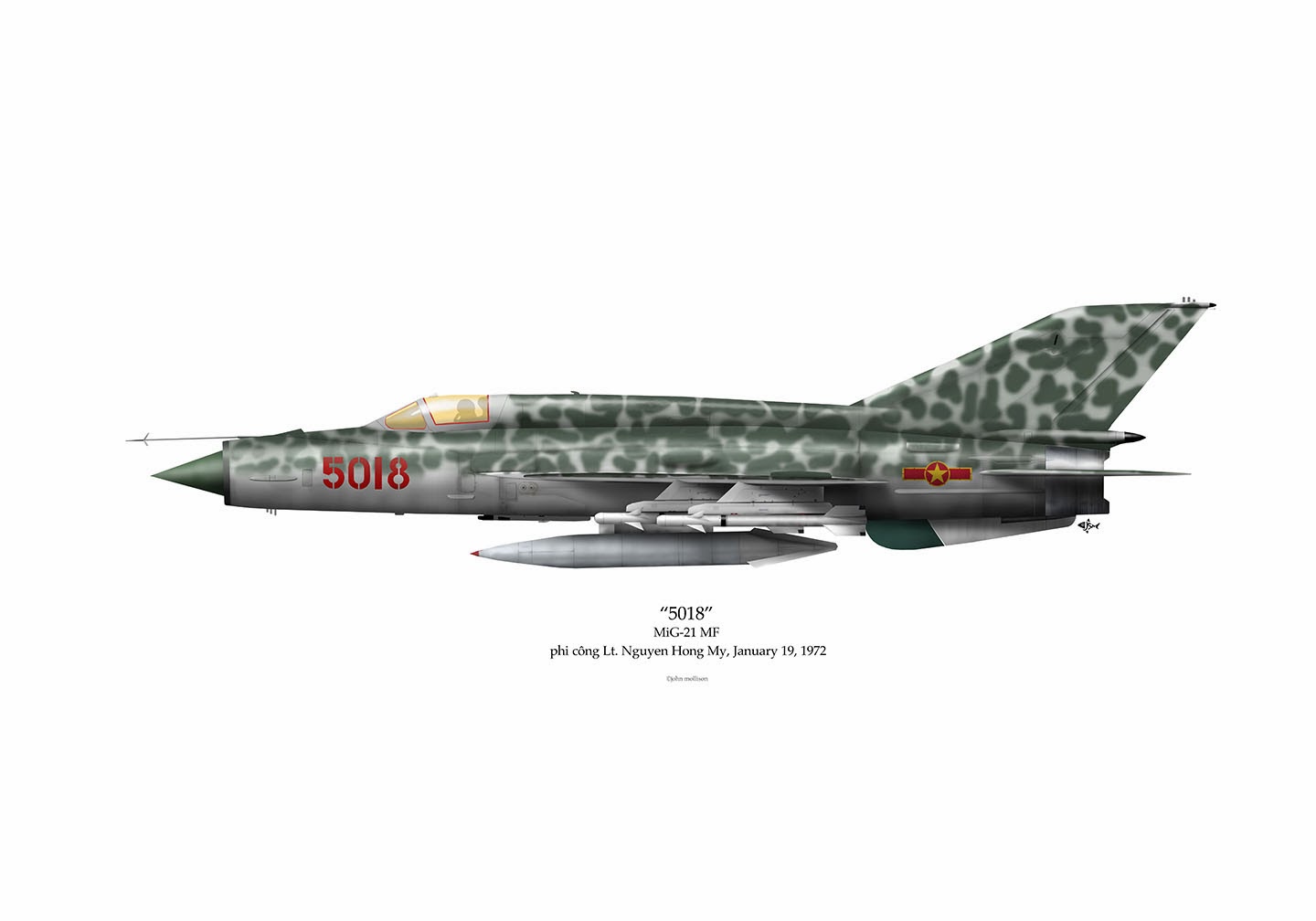
Profile 83 - FINAL/UPDATE: The MiGs of the North "5018" as flown by Nguyen Hong My and "573" as flown by Bob Mock and John Stiles.


Here it is —"5018" as flown by Lt. Nguyen Hong My, Vietnamese Peoples Air Force, on 19  January, 1972.¹

It's a sinister looking thing don't you think?  For me, it seems more like something out of a 1960s Japanese Godzilla movie than an actual, historical fighter plane.  But in fact, the MiG-21 is the single-most produced jet fighter plane, ever.  If you count the Chinese copies, nearly 14,000 of the metal dragons were built with the last ones coming off the line in 2013.

To the North Vietnamese Air Force, however, such numbers were pure fantasy as the VPAF only received about 220 MiG-21s between 1966 and 1973.  Based on typical jet serviceability, total fighter numbers, rates of delivery and a little one-eyed guesswork, it's easy to believe the common legend that the VPAF only had about 60 jets
² in-service at one time.  Tops.

It seems ridiculous to think that such a small force would be even worth the effort against the massive amount of American airpower at-hand.  Yet, they were, and they were utilized rather well.  Depending upon the source, the US:VPAF kill ratio in air-to-air combat was very close to 1:1.
³  A far cry from the WWII days when Navy F6F Hellcat pilots could boast of a 13:1 ratio over the Japanese A6M Zero!

The reasons behind the VPAF's comparative success are not mysterious.  For one, the VPAF had an excellent but frugal command and control system.  In other words, the MiGs weren't scrambled without good reason, good timing and a good chance for success.  For two, the American pilots had the burden of the attack.  Managing the target, weapons systems, battle plan, avoiding missiles, AAA and MiGs was simply more to manage than the defender's single focus.   Yet, it's perhaps the third reason that is most revealing; the VPAF had achieved the Warrior's Zen.  Pilot Nguyen Hong My said it best,  "We (felt like) were going to die.  We accepted this.  So, we didn't fight to survive any longer.  Instead, we fought to merely lengthen our life, moment by moment."

Understanding this statement may seem like an exercise in semantics but it's rather clear if you think about it; the Vietnamese air force created an ethos of efficiency. And, like any organizational culture, it couldn't tolerate those who didn't fit in. For any reason.

Ok, time for a rabbit trail.

The American "Sidewinder" missile is one of the great weapons of all time.  It's simple, cheap and so effective, its obsolescence is still at least twenty years away.  Pretty good for a 1950s design!  It is also so good that the Russians, when they got their hands on one in the early '60s, didn't bother to improve it.  They just copied it lock-stock and fin and called it the K-13.  NATO, on the other hand, called it "Atoll."

If you've ever wondered if anyone ever really used high school trigonometry after graduation, the guidance system designers of the Sidewinder did.  In a nutshell, a little temperature-seeing "eye" is in the nose of the missile taking regularly spaced "pictures" of the target ahead.  When the eye sends a picture to the missile's "brain," it compares it to the previous one; the differences result in rapid flicks of the missile's fins to keep the missile following the trail of heat generated by the other jet's exhaust.  This is why Sidewinder missiles are called "heat seekers."

Anyway, MiG-21s used Atoll missiles.  Most 21's carried but two.  But the MiG-21MF, like Hong My flew, carried four. 


Ok, so to the VPAF bean-counters, four missiles should be four times as effective.  Right?  Well…maybe not.  See, missiles are a lot like your wife buying a dress on the internet - it looks one way on the screen but when the dress is removed from the cardboard box and held up in front of the mirror?  Maybe n0t-so-much.

Under ideal conditions, the Sidewinder generated a 90% success rate.  In combat practice, it only had an 18% success rate.  That’s a 72 point spread!  So, in other words, the Sidewinder system was one that depended on a large number of variables for success.  It's a lot like how hamburgers almost never look exactly like the photograph on the menu board.  No one says they NEVER look EXACLY like that, but we all know they don't!


 Now the above numbers were for American-made Sidewinders.  The Russian-made Atolls were supposedly far less effective due to manufacturing inconsistencies.   Kind of like what would happen if Burger King tried to copy the Big Mac.

Follow me?

Ok.  Back to Hong My's MiG-21.

Now, remember the Vietnamese penchant for efficiency?  This meant that their time-on-target was carefully calculated to be the least amount of time with the greatest chance of success. At first blush, Hong My's 4-missile MF variant, with twice the regular firepower, should have doubled the chance of success.  But it doesn't necessarily work that way in an environment that is constantly dynamic and a system that operates under complicated variables.


In other words, a practical x% hit-rate might be expected for two missiles, but four would not necessarily generate a 2x% hit-rate.  It's quite possible that, on a missile by missile basis, 4 missiles may actually have been less efficient than 2!  

Follow me?   That’s ok.  I’m sorta lost too...

'It's time to bring Hong My back into the conversation.

"On 17 January (1972), I was in flight with Khuong Le (another VPAF pilot).  We were directed towards a large formation of, maybe, 30+ US aircraft.  We maneuvered in and each of us fired our missiles. Eight in all…”


Alright ONE MORE rabbit trail.

The Vietnamese weren’t foolish.  
As precious as the missiles were, as valuable as the MiG-21s were,  the pilots were even more so.    The VPAF weren’t going to put their best and brightest against an American formation in a suicide mission.  So, if Hong My were to survive against long-odds, he was going to have to take a 4-missile pot-shot and get the HELL OUT OF THERE!

“…but no shoot-downs!  I landed and was disciplined (by my superior officers). 'You can't fire missiles and not hit!' Me being a good pilot was not good enough; I had to prove it.”

To some people, there's an inherent unfairness in being chastised for "bad luck."  Yet, those who have accepted the mantle of Responsibility understand that luck doesn't can't exist.  Responsibility can only be born by a human being.  Looked at another way, if a missile success would bring glory, a missile failure, no matter how intangible the cause, should likewise bring shame. 


And so it was, 17 January, 1972.  

Ok.  Time to introduce you to Lt. John Stiles...


...and my artwork of his RF-4C Phantom.


Now.  Have another look at 5018 and notice the date.  Obviously Hong My got another chance to fly with four missiles.

But this time, he would only use two.

Stay tuned...

¹There is some question between records whether the event was on the 19th or the 20th.  More research is going into this question at a later date.
²Jets of all varieties - MiG 17, 19 AND 21s.
³My sources varied between 1.2:1 and 2:1 in favor of the Americans.   There's a LOT more to this and I'll cover it in a later post.
Hong My remembers having a number of missiles shot back at him, too.  That he or his wingman weren't hit only adds to the mercurial nature of the technology.

14 December, 2013

Profile 83 - UPDATE: The MiGs of the North; "5018" as flown by Nguyen Hong My


Imagine a penny.

I know what probably came to mind—coppery, somewhat dingy and Abraham Lincoln’s profile.   And it wouldn’t surprise me one bit if the 40-some percent of readers that come from elsewhere in the globe, imagined the same thing.  The American penny is ubiquitous.

But what of the back?  How many of us imagined that side?  Probably a smaller number.  And of those that imagined both sides of the penny at the same time? Minuscule, I bet. Yeah, yeah, the “History is like a coin because it has two-sides” phrase was minted long ago.  But that doesn’t mean it’s no less true.

Alright, pause for a moment and have a look at the MiG above.


The picture shows my progress-shot of a MiG-21 fighter that Hong My flew during the 1972 air war over Viet Nam.   Hong My was put into the spotlight a few years ago when General Dan Cherry wrote a pretty-cool book about how he shot Hong My down and later on, met him and became friends.  The book is called, “My Enemy, My Friend.”  Read it.  It’s good for you.  However…

One more time...I need to digress again.

So, Dan, upon learning of my trip to Viet Nam, suggested that I meet Hong My and helped get us introduced.  It was a supremely cool experience save for the vast language barrier.  Hong My knew about five times more English than I knew Vietnamese (I know how to say 'Hello,' 'Shrimp' and 'Beer'). In other words, the conversation quickly degenerated into my ridiculous attempts at pantomime and Hong My’s gracious patience. 


I felt utterly foolish and feared that I was wasting Dan’s endorsement and Hong My’s time. But toward the end of our “conversation,” I asked the question, somewhat absentmindedly, “You? Shoot down? Any of…us?”  I pointed at my heart.

Momentary silence...


His eyebrows raised, then lowered.  Then, in a quick gesture, he flicked his finger across his chest and stated firmly but quietly, “Yes.”

Boom. I understood.   And with the kind of clarity that transcends all language, all emotion, all logic.  I was sitting next to a real, bona fide, in-the-flesh, enemy.  Granted, an ex-enemy, but the first one at that I ever met who had not only fired at America in anger but had been victorious at it, too.

And I was in his town.  His country.  And I had just agreed to draw his MiG.  Not the one that Dan shot down, but the one that he used to shoot down Bob Mock and John Stiles, January 20, 1972.  In other words, “US.”

Ah yes.  The other side of the penny.

Have another look at the MiG.  We’ll see how far we can push this “My Enemy, My Friend” stuff in the next post.


And, I’d like to introduce you to John Stiles' RF-4, the airplane that wound up in  Hong My's missile-lock.

Stand by—Stiles is preparing to give his perspective on the matter...


30 November, 2013

Profile 83 - BEGINNING: The MiGs of the North; "5018" as flown by Nguyen Hong My


It is one thing to write about an enemy.  It is yet another to buy him dinner.

And yet another to salute to his honor.

Recently, I was able to spend a few weeks in Vietnam.  The experience was a cannonball-dive into the culture; I got to know Vietnam's higher education system by lecturing at several universities*, dined outside of the stream of tourists, slept with all the modern conveniences of home and quickly learned to suspend all previous notions of what vehicle traffic should look and act like.


And of course, I managed to meet a few "old guys and draw their airplanes."

The sketch above is the MiG-21 flown by Nugyen Hong My, pilot, warrior, victor and victim.  He is the first "enemy" pilot that I have met and the first enemy pilot that I will record via my artwork.   

Watch this space as Hong My's fighter takes shape and his story is told.  And recognize that 5018 merely the first of at least three (maybe more) to come.

Strap in.  We're going North.

Really North.


PS - The sketch above is rougher than my usual roughness as I did it while trying to work through a translator.  It's incomplete and vague, a reflection of the opening of a relationship that spans so many years. The blurring in the upper right hand corner is the name and email of a USAF pilot who may or may not become part of this series.

And... thank you to General (Ret.) Dan Cherry and Stuart Maas (334th TFS) for getting this ball rolling.  You'll be hearing more from them, too.

Oh!  As for Hong My,  that's him below looking at my opening sketch. Our translator, Huyen is getting a crash-course in all-things MiG...  


*Foreign Trade University, Hanoi University, National Economics University and University of Language and International Studies

19 October, 2013

Profile 82 - FINAL: "Cocktail Hour" as flown by Raymond Plank, 43rd BG, 64th BS


She's finished - it's "Cocktail Hour"!

Though I can't verify exactly how many times Lt. Raymond Plank flew her, this particular B-24 has become a most interesting symbol of his service.

Let me explain.

If you can get past nose artist Sarkis Bartigian's obvious high points, the piece itself is a brilliant look into the closing months of WW2, especially as seen through the eyes of war-weary soldiers.  Note the bright lights, big city, stars, music (and of course her).  Now, close your eyes and imagine rhythmic blasts from a swing Band in the corner, clinks of drinks and the excited, optimistic chatter of people blowing off the steam of a week's stress...

Or, as a buddy of mine is wont to proclaim around 4:30pm on a Friday, "Hey!  It's 5'oclock somewhere!" and then announce the Watering Hole in which he'll be holding court.

"Cocktail Hour" was a late-war B-24.  Though Bartigian is no longer around to interview, it's easy to see how his artwork represented the sentiment of so many; "It's time to get this damned war over and onto better things!" Indeed, the first recollection of WW2 that Raymond shared with me was not a combat mission but of a historic moment that, in his mind, sealed the end of the war.

The day was August 9, 1945, the location was an air base within the Okinawan island chain called "le Shima."  The day's missions were scrubbed,  the 43rd's B-24s grounded.  Raymond, never one to sit still and always reading between the lines, was quick to figure that 'something was up,' and managed an impromptu and unauthorized check flight in a C-46 Commando transport plane that an old buddy, Joe Sharpe, had flown in a day or two earlier.

Sneaking off like kids in their father's car, the two climbed over the ocean to the north.  Toward the crumbling empire of Japan.  "It seemed like we were flying a long time, (but that was probably) due to us doing something we weren't supposed to do!" Raymond laughed.   "We didn't know where we were going but I wanted to see if I could see it!"

What was "it"?

Fueled by a hunch, the two scanned the northern horizon, growing more anxious with each career-killing minute until,  a few minutes after 11am, poking up from the gentle curve of the earth, they saw IT— the boiling rise of a mushroom cloud.  "By gawd, that's where the sum-bitch* is!" Raymond exclaimed, laughing.  "We flew on toward it for another 20 minutes or so but then got the hell out of there!"

Raymond knew then, beyond a shadow of doubt, the war was over.

(photo: National Archives)

The next week, on August 17, three Japanese G4M "Betty" bombers, freshly painted in the universally accepted color of Surrender (white) landed at le Shima.  Though the moment was just a punctuation in the awkward, complicated process of ceasing hostilities, it was a momentous one for all present in that it was an undeniable punctuation to the times.

(photo: Raymond Plank)

"So you were there with your camera?"

"Yes.  I took that picture."

"That had to be an incredible moment!  Describe it for..."

"Yes!  I went up to the Major.  'Major Parker?  It looks like my services are no longer necessary!  May I hitch a ride to Manila?!"

"Huh?!"  I asked, confused by what Raymond was saying. I was expecting something about the sweetness of surrender, the defeat of the enemy, the triumph of the American will...but Raymond was on another track altogether.

"...and he said FINE!  What a guy.  Major Parker was a great guy!  He cared more about getting what was needed to get done than how it got done."

"So.  Wait a second.  You just...quit?"

"Well it was more complicated than that, but yes.  I had my Points (a method of scoring that would allow prioritization of returning to home based on wartime service) and I wanted to go home.  Finish my degree.  Start a business."

In other words, for Raymond Plank, the winding down of defeated engines was not the sound of victory but a metaphorical shriek of a work whistle signaling the end of one thing and the beginning of another.

Lt. Raymond Plank caught the first ship home and did exactly as he'd planned.

So, how did that work out?  Click here.  That's the business Raymond started— the Apache Corporation. Those aren't millions of dollars, they're billions of dollars.  In other words, Raymond Plank had one helluva Cocktail Hour.

It's rare enough for me to talk to WW2 bomber pilots.  Rarer yet to talk to ones that were there at momentous moments in history.  And, of those that went on to create and lead billion-dollar companies?  Raymond is the only one.  And will likely be the only one.

Ok.  Hold that thought.

People say to me all the time, "Geez it must be great to get all those old stories!"  It is!   Flak barrages, atomic bombs and topless women on B-24s are sexy topics.

But...

The more time I spend with 'old guys,' the greater my belief that we Americans are living in tragically deficit times.  Not the deficit of money, natural resources or international prestige but of the the thing that is eminently more valuable: Wisdom.

Think about it—from Social Security to Boca Raton, FL, the removal of the elderly from daily life has been so systematic, it reeks of a conspiracy to keep the rest of us in a state of foolishness.  Disagree?  Well, this past week, during the clamor of our government shutdown, very few people I talked to actually seemed to understand that we elected those people...

Look.  80% of my interview-time with Raymond has been spent on learning about the things that took him from a $250,000 ball of venture capital to over $50 Billion in market revenue.  I have hours of notes on topics like ethics, character, risk, energy policy, opportunity, reward, regret... I know it can be argued that Raymond's success is an anomaly but the truth is, I've heard it all before from old guys like Wendell Hanson, Don Bryan, Bill Creech, Steve Pisanos, Claude HonePunchy Powell, JD Collinsworth...and my list of Vietnam-era 'old guys' is growing at a priceless rate, too.

There's so much to be learned from how others have minted success from molten adversity.  That's the truly great stuff to me and I wouldn't have gotten a bit of it had I not talked to Old Guys; it's how I make up my own tragic deficits in wisdom and heartily recommended to others as a tonic for the times.

A toast to Lt. Raymond Plank the bomber pilot and Raymond Plank the Captain of American industry.

It's Cocktail Hour.

Time to get to work.

NOTE:  Raymond wrote a book.  If you want to learn something, you can buy it here.  Or, if you really want to make his day, buy it here or here.

AND...if you'd like to buy a print of Cocktail Hour, signed by Raymond, go here.


*That'd be the second atomic bomb blast over Nagasaki.

11 October, 2013

Profile 82 - UPDATE: "548" as flown by Raymond Plank, 43rd BG, 64th BS


Have a look.  I'd say it's maybe... 40% done.   Maybe.  I'm kind of grumpy about it.  I loathe the "middle" of a difficult project as it's too late to turn back and too much left to do—rather ironic considering the story you're about to read.

The next and final post will show Raymond Plank's B-24 in her sex and booze fueled glory. (smirk)  At least a B-24 that Raymond flew.  Once or twice.  Regardless, you'll just have to wait as I'm just not that good at drawing topless women.  (Too distracting).

However, to know anything about WW2 in the Pacific, one of, if not the dominant forces dictating American military strategy was the sheer size of the Arena.  Aside from continental Asia, WW2 was fought over islands sprinkled over the earth's largest ocean.  Look at the map below.  The battlefield was HUGE.  And no one appreciated the expanse below like the airman.

There are no landmarks over open ocean.  Get lost?  The choice is brutal: ditch the airplane and risk being smashed upon impact or bail out and hope the life preserver holds air (by the way, the water was full of teeth and a speck of yellow bobbing in millions of square miles of rolling ocean is nigh impossible to spot).

Thousands of men, airplanes and bombs shuttled their way to and from targets over and over and over.  Being war and all, the efforts of both sides to destroy the other were mighty; it's impossible to tell how many aircraft (Japanese and Allied) were downed over open ocean but it's safe to put that number in the thousands, too.

Frankly, it's impossible for 21st Century folk to fully appreciate what it must have been like for Raymond Plank and his crew of nine to do their work.  To know that the next five to ten hours would be marked by monotony over open water, punctuated by a few fast minutes of terror at the target, only to return home in a potentially damaged machine is jarring.

Yet last week, Raymond attempted to fill me in.

The time was early 1945.  Japan was, of course, losing the war in a big way.  The Japanese Army Air Force was a shred of its former self and the Navy's aircraft had long lost their sea legs due to the decimation of her aircraft carriers.  But, as the Japanese were nowhere near admitting defeat, they defended their targets against the Allied aerial armada with legendary ferocity.  Namely, "Ack Ack" or, anti-aircraft guns.

On this particular mission—the actual date lost for the moment, but we'll get that figured out—the target was a Japanese air field on the island of Formosa (now Taiwan).  From the freshly recaptured Clark Air Base in the northern Phillipines, the trip was approximately 1,000 miles round-trip.  In case you're wondering, that's a 6 hour trip.  Half over water.

Ray remembers the approach rather well.  The flak began as the peppering of black smudges in the tropic sky and soon rose to a crescendo of unusual violence.  Though a 30 ton giant, Ray's B-24 still shuddered under the impacts of supersonic shards.  Against the roar of the engines, the delicate "tink!" and "dunk!" of flak pieces were deceptively subtle.

Want to get a feel for it?  Click on the movie below, (it might take a second to load) turn your volume up all the way and imagine small handfuls of rocks being tossed at your window...(I made that little film while riding in a B-24, btw).


"We were taking very heavy flak.  Very heavy." Raymond stated in his distinctive, scholarly drawl.  "And then, a 120mm (guessed) shell perforated our right wing.  The entry hole was about the size of the projectile but the exit blew all to hell.  So much that the rubber seals in our wing tanks were obliterated and gasoline streamed out."

Stop there.  The Japanese 120mm gun fired an explosive round.  In Raymond's case, however, the round did not explode.  It simply passed through the wing like a hot poker through a candle.  Had it exploded, Raymond Plank and crew would have been blown to pieces over the China Sea.

With reflexes honed by repetitive training, Raymond quickly feathered the #1 engine to eliminate the chance of a spark igniting the raw spewing into the atmosphere.  Did they complete their bomb run?  Jettison their bombs?  Raymond doesn't recall.  All he remembers is the gentle, ginger sway out of the formation to get out of the combat area and head for home.

With one dead engine, a dramatic loss of fuel and hundreds of miles to fly, the return flight was, to say the least, nervous.

I tried to capture the moment with my iPad using my brand-new Wacom pen.  It's cheesy, but I think you'll get the gist of what it might have looked like to take a hit in the wing....*


What I couldn't draw is what was happening in the cockpit.  In the fury of the moment, Raymond began to realize that, in addition to the seismic damage to the airplane, three men in his crew were wounded; casualties of the blizzard of metal they'd flown throw.

"Our nose gunner took a piece of metal to his foot.  He was screaming like mad..." Raymond explained.  "Our bombardier pulled him back to behind the flight deck.  He was bleeding a lot, so he decided he needed a tourniquet.  (Once that was applied), he pulled off the boot and worked the jagged metal through the foot.  It had to hurt like mad!   He loaded him up with (morphine) and sulfa powder."

One of the waist gunners took a piece of flak to his head.  Fortunately, he'd put his combat helmet at the first sign; the piece dented the helmet and bruised the soft tissue.  Surely without the helmet, the gunner would have been killed instantly.  The tail gunner too was hit, his specific injury lost to the the passing of seventy years of life...

"We'd made it back to base.  An ambulance, a fire truck and a Chaplain were waiting for us,' Raymond explained. 'But our left tire was in shreds.  It'd been hit by flak.  We couldn't land with only one tire or else we'd ground loop (essentially a high-speed spin-out on the airstrip).  We knew we had to equalize the landing gear somehow so I got out (Raymond was co-pilot on this mission) and went back to the waist gunner's spot where we held one of the crew out the window into the slipstream where he could blow out the tires with a .50 cal."

Yes, I asked.   "Really!?  You hung a guy out with a .50 cal. machine gun to shoot the tire?!"

"Yes." Raymond replied matter of factly.  "I held onto him and someone else was hanging onto me!"

(Note: If the sight of a man trying to manage the explosive power of a Browning .50 heavy machine in the raging slipstream is too fantastic to imagine, please know the crew tried to shoot out the tire with a .45 sidearm pistol.   The taught, reinforced rubber only deflected the big bullets, necessitating the raise in calibre.)

Minutes later, the B-24 ground its way to a halt at Clark, a battered wreck.  With the wounded quickly Jeeped to the base hospital, the crew stood back to appreciate their mount; it was holed 367 times.  Unworthy of repair, a few necessary parts were stripped and the rest of her pulled to the side and tagged for scrap.

Raymond, on the other hand, had no idea that he had inaugurated a charmed life...

And, you'll read about THAT in the next and final post of Raymond's B-24.**

* ** Update:  Just got off the phone with the man (Raymond).  He and I had a miscomm; in the little animation, I drew the #3 taking a hit when instead, it was the #1 (outboard).    Also, Raymond wanted to make sure I got the point across that he flew a number of B-24s; three of which were written off.  The B-24 to follow will be no more "his" than any of the other crews that flew her.


06 October, 2013

Profile 82 - BEGINNING: "???" as flown by Raymond Plank, 43rd BG, 64th BS


He stated it three times in expressing the one thought.  Each time, he spoke the word in that old-school fashion of putting the emphasis on the last syllable.  Like a command.  Like a privilege.

"They gave me responsibility.   I was 22 and had responsibility.   The responsibility of 9 men and of killing thousands of Japanese."

But I didn't hear the word at first.  I was still stuck on the "9 men" and "Killing thousands of Japanese."

He held eye contact for another brief moment—crisp blue eyes in a face of delicate features, chiseled and smoothed from 92 years of life—then returned to buttering his pancakes, allowing my mind catch up to what my ears had brought.  It was then that I understood what he was saying.  Responsibility is not a thing or a task.

Responsibility is power.  And if you have responsibility for something, it's a big deal.


Ok.  Have a look at the B-24 above.  It's going to change a lot as I'm not quite sure on the particular serial numbers, nose art and model.  Drawing the oddly shaped B-24 is an additional challenge because the type had so many different variations...

I'm not complaining.  The B-24 that I settle upon will be one flown by Lt. Raymond Plank of the 64th Bombardment Squadron, 43rd Bombardment Group during the final but shockingly vicious months of war against Imperial Japan.  This morning's breakfast with Raymond generated six pages of notes including one particular story that I'll share in the next post.

However, the most fascinating aspect to this story is not the moments of terror and hours of anxiety over ocean and enemy but Raymond's whole life of...

... responsibility.

Stay tuned.

20 September, 2013

Profile 80 - FINAL "837" as flown by MISTY FAC Dick Rutan + Rutan Voyager


"I was out of my body, looking down... looking down at the war beneath.

I saw two armies.  One of life, the other, death.  And they clashed.

I knew they were fighting over me."

A thousand regrets for not having something to record the audio!  Dick Rutan, adventurer, inventor, warrior was describing an utterly outrageous experience, one that defied reason.  And my hand's ability to keep up.  Damnit!

"And this was in the Voyager!?" I asked incredulously.

"Yes.  One of our training flights."

"You were...breaking down..?"

"Yes."  Dick's reply was crisp, abrupt; a statement of fact.  But there wasn't any shame in the apparent loss of control.  Instead, Dick spoke with the analytical detachment of a scientist.  I knew then that this was a guy who had learned to keep his cool even when things got insanely hot.

"(They were) Gremlins.  The Voyager was not a safe aircraft and it tested our limits of endurance.  I was tired, hadn't slept for 30 hours and hallucinating, seeing Gremlins.  I had to learn how to manage those stresses.

I can tell you this, if we hadn't trained and learned like we did, there would have been no Voyager mission."

And that's what my first conversation with Dick Rutan was like.

In December of 1986, Dick and fellow Voyager pilot Jeana Yeager flew the spindly Rutan Voyager on a non-stop flight around the world. Though I vaguely remember the headline-making moment, it had little significance to me until this year's commission. In my youth, my distraction of the moment, I'd just figured a team of airplane nuts got together to set a record.

However...

...when the project came along to do Dick Rutan's Vietnam F-100F and Voyager, I was gobsmacked within the first 15 minutes of research.  The round-the-world record was no lark.  Instead, it was the culmination of five years of science, engineering and forced mastery of the black art of "Human Factors" - the study of how humans interact with the systems they create.

Ok, have another look at "837" above— it was one of the F-100's Dick flew as  a "MISTY" Forward Air Controller (FAC) in Vietnam.  It bears a clue into what it took to mint the mind that could, on one hand, hallucinate in the cockpit of an experimental aircraft and on the other, retain the rational presence pull his faculties back into sanity without losing control in the process.

MISTY was the callsign for the FACs who loitered their F-100Fs above the North Vietnam countryside spotting targets for the whip crack of an air strike.  But while the air strike came and went, the MISTYs stuck around snooping out the next target.  This nearly constant battle-field presence cost them; MISTY's suffered a stunning 23% loss rate.

I can only imagine that, 20 years later, while trying to tame his exhausted faculties, the Vietnam jungle reached out from beyond sanity and tempted him with doom.   How & why he overcame the trouble is mine to discover because in a couple weeks, I get to spend more time with Dick.  In fact, I'm taping him for my "Old Guys and Their Airplanes" project (yes, I'll post it).  It'll be ready (probably) by the end of November.

I realize there are readers 'out there' that are like me and would really appreciate the chance to meet the man but the opportunity isn't likely to present itself.   So.  If you'd like to ask Dick Rutan a question, here's the next best thing:  Email me (click here).   If your question is chosen, you'll get a print showing both the 100 and the Voyager and I'll also ask Dick to sign it for you, too.

And, make it a good one, too.  I suspect he likes challenges.


PS - get your question in before October 3, 2013.