15 September, 2013

Profile 81 - BEGINNING: "879" F-100D Super Sabre of the 531st TFS


Last week, I was asked, "Is drawing airplanes hard work?"

Hmmm.  Interesting question.

Have a look at my pencil sketch above—it's an F-100D of the 531st TFS based at Misawa AB sometime in 1963.

The hard part, getting the markings established, is pretty much done. Thanks to a half-a-dozen people around the world, I was able to learn that 879 had as many as seven combinations of markings applied between 1960 and 1965.  And the stakes were high to get it right for 1963—the finished piece will go on display as a testimony of gratitude between one guy to another.  In this case, historical precision is no mere feature, it's an integral part of the commission.

I can't begin to count how much 'work' went into these people's sifting, sorting and cross checking pictures, dates, places... researching markings is hard work.  It takes experience, intuition and, of course, a stack of photos.

Now, it's time for the hard part, actually doing the artwork.

Have another look.

Right now, 879 is, of course, a gray pencil doodle.  But, she'll come to life as she was—a sharp silver shark splashed with slices of red, white and blue.  Such paint jobs (there are some really wild pre-'65 color schemes out there) were the order of the day.  Looking through hundreds of F-100, F-101 and F-102 photos, it's tempting to believe that the USAF had a graphic-design department staffed with Art School beatniks.

And how hard will actually doing the airplane be?  (laughs).  No idea yet...I joke that the busy parking lot outside my Studio is a time machine.  I park my car in the bright of morning and fifteen minutes later, it's night time and the only car left.  So...maybe...45 minutes of hard work?

(joke)

Anyway, by appearance, 1963 seems like an easy time.  But I know better.  There are no easy times.  Ever.  The illusion of hard vs. easy is simply a matter of choosing which details to pay attention to.

In 1963, America was RIGHT on the bubble between the prosperity and paranoia of the Cold War and the rage and change of The Vietnam Era...and if you want to "see" what it looked like when the bubble popped (click here)...

Did you click?

Really...do so (it's not that hard).

So.  Is drawing airplanes hard work?

Not really.  It's just life.

Oh.  And here are a few wild F-100's.  Before they received the much more workman paint jobs of green, dark green and tan.*

Photo: Vince Reynolds via Replica In Scale

Photo: Phillip Friddell via Replica In Scale

Photo: R. Franke, via Replica In Scale

*That'd be the other side of the bubble called "Vietnam."

29 August, 2013

Profile 79 - FINAL: "314" as flown by Lt. Col. Farrell Sullivan and Capt. Dick Francis


The following is from Dick Francis' son, Gavin.  He responded to my request for insight into what it was like to experience his dad's POW event.

It is unedited and presented in its entirety.

There are 17 paragraphs, but I suspect they'll be worth your time.


*************
"I apologize for taking so long to get this to you. It has been a busy time. I am on vacation now, so I’ve had an opportunity to reflect and focus. This all happened long ago, so the actual details may have been a little different than I remember them. But this is what I recall:

I remember the day that we found out that my father had been shot down. I guess I was about 6 years old. My father had received his next assignment to the Philippines, and my mother, my younger brother, and I were staying with my maternal grandparents in Tulsa, Oklahoma, awaiting our move while my father was away on temporary duty, flying missions in Vietnam.

It was a sunny day, and from the backyard where I was playing, I could see a blue Air Force staff vehicle pull into the driveway along the side of my grandparent’s house. Two uniformed men got out of the car, put on their caps, and I immediately ran inside to tell my mother that some Air Force people had arrived. She met the two men at the front door, and then quickly asked my grandfather to take me back outside to play.

Although I didn’t fully comprehend the situation, I realized deep down that something was wrong. And later that evening when my mother explained what had happened to my father, I cried. I didn’t really understand where Vietnam was or why my father was there. I just knew that my father flew airplanes for the Air Force.

Not long afterward, the North Vietnamese released propaganda film footage of my father receiving medical attention in a Hanoi hospital after having been captured. One of the Tulsa television stations, KTEW-TV, acquired a copy of the footage for their news broadcast. Jack Morris, a local anchorman, invited us down to the station to see the film. In the darkness of the viewing room, we all watched the film to see what my father looked like, searching for some sign that he was okay. I was disappointed that seeing the film didn’t bring me any real assurances, and I still felt sad that my Dad was far away in a strange place where people didn’t like him.


Jack Morris, KTEW Anchorman (1921-2010)

(on)...reflecting on how television news had changed from his time as an anchorman, Morris noted that “there’s a little more show business than there was in those days. We were dead serious about the news. When you’re talking about death and taxes and all the sadness that makes up the news, it’s no laughing matter.”


After that, I began watching Jack Morris in the evenings with my grandfather to learn what was happening in Vietnam. Anytime there was film footage, I would scan the background to see if I could see my father, hoping that he had escaped and was trying to get home.

That was a difficult and confusing year for us. My mother had her hands full taking care of me and my brother, Ryan, who was only 9 months old. We’d already shipped our car and belongings to the Philippines. The military was able to ship everything back to the U.S., but we had to find a place to live. And without my father around, it was hard to know exactly what the future had in store for us.

Initially, my mother rented an apartment near my aunt and uncle in Shreveport,Louisiana, where she had grown up. I started the first grade there, but within a month my uncle was transferred to a new job out of state, and without any family support in Louisiana, my mother decided to move us back to Tulsa.

In Tulsa, my mother rented a house a few blocks away from where my grandparents lived. All of our belongings were shipped there. And that’s where everything stayed, in cardboard boxes stacked up around the otherwise empty house. We never actually moved into the house. My Mom and I really didn't want to live there. I think that setting up house again was just too much for my mother to deal with. Instead, we stayed with my grandparents and would occasionally visit the rented house.

I started school in the neighborhood at Robert Fulton Elementary. I was having problems learning to read, so my teacher put me in the remedial reading group. I was embarrassed by this, and the fact that my teachers and all the other kids knew that my father was a POW only made me feel more self-conscious.

During that time, I became increasingly frustrated with the folks over in North Vietnam because of their unwillingness to let my father come home. At one point, I devised a plan to go to Vietnam myself and bring my father back. I told everyone my intentions, packed a suitcase, and dragged it down the street a block or so before my grandfather came after me and helped me carry the suitcase back to the house.

One day, we went with a number of other local families of POWs to Oklahoma City, probably to Tinker AFB, where I met with a psychiatrist along with the other kids. The psychiatrist was obviously there to evaluate us, and he asked us to talk about how we felt about our fathers being held captive. I was one of the younger kids in the group, but I think I was able to express myself pretty well. I was glad to be able to talk to someone about how sad I felt.

My mother became friends with another local woman whose husband was a prisoner in Vietnam. She had a daughter about my age, and we would sometimes get together with them. I was vaguely aware that the woman was an activist of sorts, who had become involved with the National League of POW/MIA Families. Although her daughter was a little older than I was, we would sometimes play together, and I remember being jealous when we found out that her father was being released. But it was also exciting because it meant that Dad might also be coming home soon.


There was a group called VIVA (Voices in Vital America) which made bracelets, which a lot of people were wearing back then. The bracelets had the names of service members on them who were listed as POW or MIA. You were supposed to wear the bracelet until your loved one came home. I wore my father’s bracelet. It was a constant reminder to me that he was far away in a prison cell somewhere, but wearing it was a way for me to stay connected with him, and to keep hope alive that he would return someday.


Eventually, a cease-fire was declared, the war ended, and we found out that my father would be coming home. My father was released in March 1973, three days after my seventh birthday. We went to Wichita Falls to meet him when his plane arrived. I remember how anxious I was waiting for him to step off the plane. I was so excited. My paternal grandmother and grandfather were also there. And although it was a joyous occasion for all of us, it was also very stressful. My grandfather had been taken prisoner by the Japanese during World War II, and had been part of the “Bataan Death March” in the Philippines. I think we thought that his presence might help to make things a little easier for my Dad because of their similar war-time experiences. But my father had been through a lot, he was very thin, and I think he may have been dealing with severe emotional issues. None of us really quite knew what to expect, but all that mattered to me was that my father had come home and I was glad to have him back.

It’s hard to say how the war and his imprisonment affected my father. After he returned to active duty, we ended up at Seymour-Johnson AFB in Goldsboro, North Carolina, where my parent’s marriage soon fell apart. Although my parents had been married for 10 years, they married very young, and I believe they’d always had problems. Indeed, my father was still in his twenties at the time he was shot down and captured. Obviously, such a traumatic experience would have a profound effect on anyone, especially someone of that age, and I’m sure that it affected him deeply. But after 40 years, it’s hard to know these things for sure.

At any rate, I’m very proud of my father and of his service to our country. I have a great appreciation for him and for all the men and women of the Armed Forces who have put themselves in harm’s way. 


Thanks very much for asking about my memories. I’m glad to have the opportunity to share this part of my father’s story with you."

Gavin


*************


Pictured:  Gavin, Dick, Betty and Ryan Francis, c. 1973, shortly after Dick's return the United States.

Note:  My editor read this post and made the comment that Gavin's story illustrated to him how no single man or woman goes to war alone.

22 August, 2013

Profile 80 - IN-PROGRESS: "837" as flown by Dick Rutan, MISTY 40, 612 TFS


I'll never forget the start of The Iraq War—March 20, 2003.

Not because the moment engendered any kind of patriotism or political rash but because of the reaction I got from others.  See, I was preparing to go to Europe with a few WW2 vets and the media was rife with stories of anti-American this and that.

I can remember distinctly one person, a family friend, being astonished that I didn't cancel my trip outright.  "You're taking a big risk!" she warned in a hiss as if to thwart the piqued ears of foreign spies.

And then there were...maybe, ten, fifteen more people who offered similar advice.  I remember another, "Well, if it was me, I'd sure think twice about going!"

Normally, I'm not the brightest bulb in the room.  So, I've developed the good habit of seeking advice when it comes to matters of question.   And the advice I seek is usually from those whom are counter to the first proposition.  In this case, I asked a man who was quite familiar with war, Europe and 'risk.'

I asked Punchy Powell, one of the WW2 fighter pilots I was intending to accompany.  "Punchy?"

"Yeah?" he replied in his collard-green drawl.

"This war in Iraq.  How you feel about that in light of our trip.  I mean, are you..."

"Wur-ud?" He interjected quickly.

"Well..."

"We go!  I learned a long time ago that if I was afraid of the little things, I'd be afraid of everything!"

In a flash, the well-intentioned but fretful faces of all those folk flashed before my eyes—teachers, weight lifters, managers, doctors—and I realized. These people were afraid.  And it wasn't so much the fear of something real, it was the fear of something possible.    And it struck me—they didn't seem to have the internal confidence that Punchy had.  They hadn't learned to control the fear of little things that was necessary to see the big things as—not fear—adventure.

Bottom line, I went and had a BLAST.  New friends, awesome sights, amazing history...and I was even cursed by a Parisian grocery store clerk (evidently, my American-ism was rather obvious).  To think that I would have lost all of what I gained on account of prudent possibilities makes me shudder.

I learned:  "Adventure" is not so much an act as it is an attitude.

Ok.  So what does this have to do with Dick Rutan's F-100F?    In the event you don't know the name, you may remember that strange, spindly white airplane that flew around the world back in December of 1986.  That airplane was called The Rutan Voyager and he and fellow pilot Jeana Yeager flew it around the world, NON STOP.

It took nine days, entirely in the air, in a cockpit smaller than a farmyard propane tank!


Nine days of eating, breathing, pooping without touching earth—much of it over water—pretty much qualifies as an "Adventure."  And I wonder how many people thought the act was madness.  "Dick, really now.  Isn't just a little foolish to get into that thing and..."

In a few weeks, I get to sit down with Dick and learn what it takes to live a life of obvious risk, boundary pushing and accomplishment.  Of course, I'll share what comes of that with you, too.

But, I suspect that such a life begins in-spite of all the admonishment with the words, "We go!"

Stand by...


05 August, 2013

Profile 79 - UPDATE - "314" as flown by Lt. Col. Farrell Sullivan and Capt. Dick Francis

It's a question that is so difficult to ask but impossible to leave behind...

"What was it like?"

It's the question that everyone seems to want to know but for a writer, it's a diabolically difficult one on account of the fact that what I'm really doing is interpreting someone else's perceptions.   Believe me, it can be mind-melting to bring a moment of the past to life and keep the integrity of events and people intact.

So, I'm going to take a different course with this post.  You have a chance to hear Dick Francis describe what it was like to be shot down and taken captive.

Click here.


14 July, 2013

Profile 79 - BEGINNING: "314" as flown by Lt. Col. Farrell Sullivan and Capt. Dick Francis


You never know.

Until you're there.

But, you can prepare.

Ok.  This post marks the beginning of "314" - an F-4E Phantom shot down over Hanoi, Vietnam.   Just to be clear, when I wrote "over Hanoi..." I meant directly over Hanoi.  Smack-dab.

Pilot Lt. Col. Farrell Sullivan and Weapons Systems Operator, Capt. Dick Francis were blown out of the sky by a North Vietnamese "SAM" missile during a mission over the city—a city that has, to this day, the distinction of having the most formidable anti-aircraft defenses ever developed for a country 'at-war.'

Dick became a POW.  One of 766.

Sullivan became KIA.  One of 47,378.

Yeah, they're sobering numbers.  But really now, how many of us are really effected by them?  After all, they're someone else.

Hmmm.

I'm going to ask Dick to describe what it was like—to go from utter power to utter helplessness in the span of minutes.  From having more firepower than a WW2 B-17 under-thumb to having the dirty barrel of an AK-47 assault rifle shoved under-chin.

Having heard a few of these stories from others, I know you're going to find Dick's story to be fascinating. 

But there are three people out there who have a surprise coming; I have no idea how that's going to go.

Kind of like Dick how felt the morning of June 27, 1972.

For him, it was, just another mission.

For someone else...?

Stay tuned.


27 June, 2013

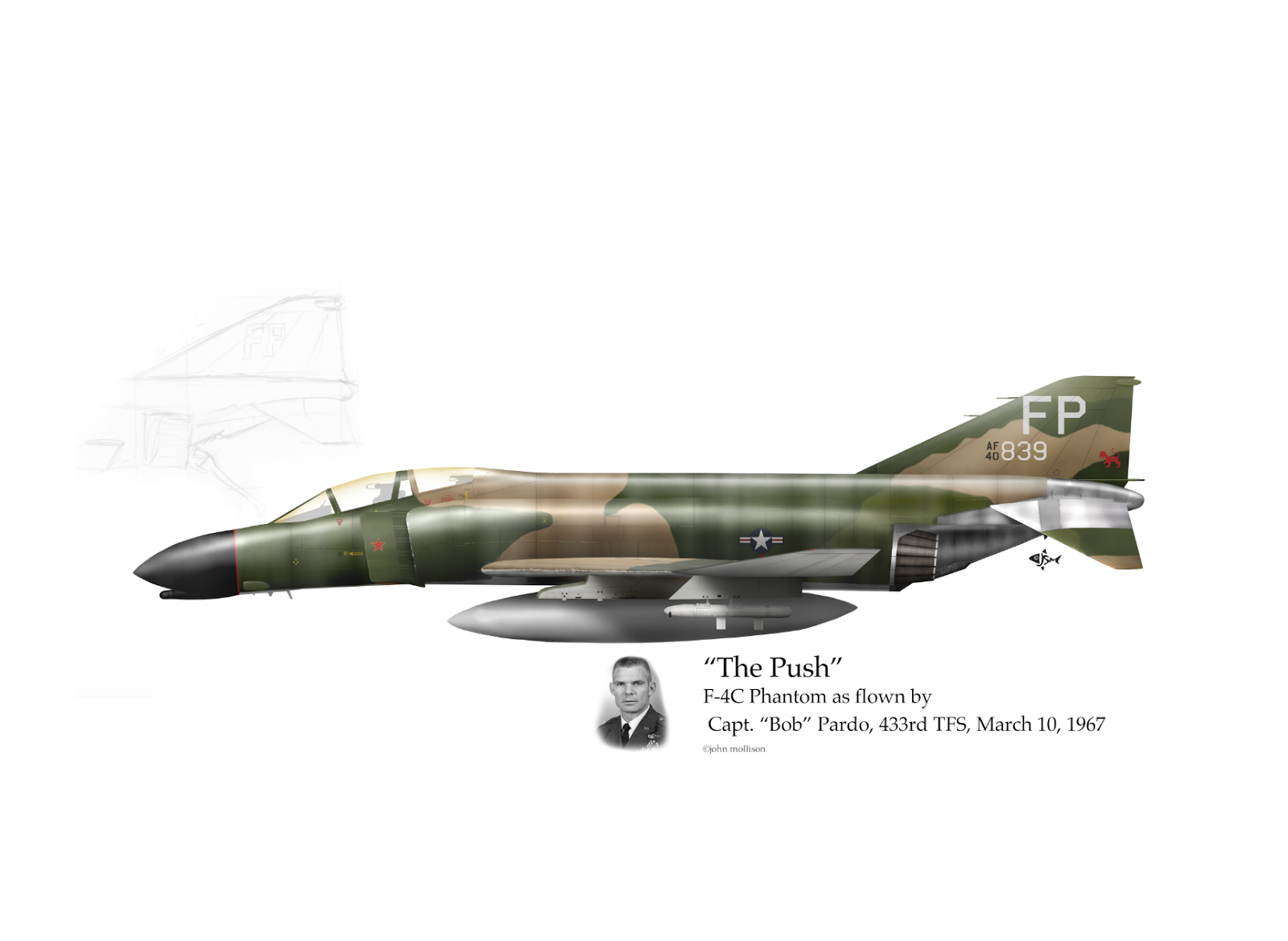
Profile 78 - FINAL: "Pardo's Push".

Do you remember when President George H. Bush talked about the "Thousand points of light"?  The actual quote was something like, "...America moving forward, always forward—for a better America, for an endless enduring dream and a thousand points of light."

In today's glitterati world, there are thousands of points of light going off every second—they're called "paparazzi."  No disrespect to President Bush or even the hard work of those who follow Miley Cyrus around but I haven't seen so many points of light as I've seen points of Bullsh*t.

Whatever.  My point of view isn't anything new.  But I will say this much—at some point or another a person comes to the crossroad that their actions either matter for the greater good or they don't.

But even then, what does something good look like?  Does it look like Miley Cyrus?

Hmmm.   Well, as far as I've learned, if you turn your eyes toward Texas, and squint really hard, you can see a point of light named Bob.  Pardo.  That's him on the left.


This isn't the place for the back story of the famed "Pardo Push."  Click here for that.  Instead, this is the place for you to learn a quirk of the story that might brighten your day.  Especially if you're in the dark of cynicism.

A couple nights ago, Bob and I were talking about his defining moment and I was trying to figure out why Bob did what he did.  Offhandedly I asked, "So, (Lt. Earl) Aman was your wingman..."

Bob interrupted, "No.  Earl was not my wingman."

"Somewhere I read that Earl was a wingman..."

"That's wrong.  I was #2.  Earl was #4.  My leader and Earl's leader had head back to base."

Hmmm.  Headed back to base, eh?

"What do you mean headed back to base?  You mean they left?"

In case you don't understand the significance of what Bob just said, look at the illustration below. The leaders are second and third from left.  These are the guys that are supposed to lead—both the mission and the example.


To be fair, I haven't talked to either of the leaders that flew in that four-ship on March 10, 1967. All I know is this—Bob Pardo and his backseater Steve Wayne, though flying a combat-damaged F-4 themselves, stuck around to help Earl Aman and his backseater Robert Houghton when the 'leaders' didn't.

Anyway, I wondered why Bob stayed with Earl.

"You and Earl must have been good friends, yes?"

Bob replied,  "No.  Well, sure, I guess.  Earl was in my squadron..."  In other words, Earl was just a guy in Bob's squadron.  Cordial, friendly, sure.  But best buds?  No.  Kind of like the guy from work who rounds out your golf foursome a few times a summer.

Anyway...

"So why did you do it?  Why did you risk everything (your life, your military future, possible imprisonment) to save Earl?"  My pen was ready...

"Well.  I guess...my dad. Yeah.  It was my dad.  He taught me...I guess, that..."

Ha.  Bob Pardo didn't have a pat answer.  At least nothing other than a tangental ramble of how his old man taught him this and that.  In listening to Bob's Depression-era family and having to work hard, there were enough aw-shucks moments that I wondered if Bob wasn't a little too good to be true.  See, I remember something about WW2 ace Pappy Boyington saying that behind every hero was a bum.

And that's fine.  I can accept that Bob Pardo is human.  In fact, I'm sure he's flickered a few times.  Maybe gone-out altogether, too.  I don't know.

But I do have another picture to show you.  Look below.

That's Bob on left, Earl at right.   The quality of the photo isn't great but I think you can see for yourself that Earl is in a wheelchair and on a ventilator.  Here's the backstory - in 1994, Earl was diagnosed with Lou Gehrig's disease and by the 28th anniversary of "The Push," was being fed through a tube.


And the T-shirt on Earl's lap is one of 3,000-some t-shirts that Bob and a network of friends bought and sold to raise money for Earl's chair, ventilator, computer...

"Did you know Earl was in one of the first classes of The Air Force Academy?"  Bob asked conversationally.  Of course I didn't.  And there's no way I could have - Earl died from the disease in 1998.  But Bob sounded pretty alive when he proclaimed, "We got him a van so he could go to his reunion (in 1996)."

Did you catch what happened here?  The friendship?  The continued sense of duty?  The strength of the brotherhood?  The, dare I state it, "leadership"?

Bob's no point of light.

Bob's a torch.

And I tell you what—I think this was the kind of stuff President Bush was talking about.

Ok. Back to the guy who commissioned me to do this piece, he's an ex-POW who thought Pardo's "push" was a momentous act of humanity and worthy of space on his office wall.  "You're going to like Bob.  He's the real deal."

He is.  And now I know what a point of light looks like, too.

Meet Dick Francis.  Read about him here.  His story isn't so much about being a "point of light" as it is igniting new ones.

I start his F-4E next and hopefully, when we're done, Dick will have lit three more.

Photo


PS - Bob has asked that I work with him to benefit his charity, the "Air Warrior Courage Foundation."  There are a very limited number of prints of my artwork, signed by Bob, available and a sizeable portion of each sale goes to the AWCF.   SOLD OUT.


05 June, 2013

Profile 78 - "Pardo's Push"


You know, they're all interesting.  And they're all thought-provoking.

And they're all important.

"They" are The Stories I get to hear.   And the more I hear, the more I become convinced that Combat and Peace are more alike than not.  Both have their moments of bone-chilling fear, horror, courage and victory... as well as monotony and, ironically, peace.

For me it works like this—I'll be in the thick of something, from business to yard work and suddenly, I'll remember a story and my perspective will change; somehow, inspiration will come and a fresh outcome will occur.

Maybe that's why studying History is so important—it's the story of "us." Minute by minute, we climb a little higher atop the shoulders of giants of the past.*

But, there are those stories that somehow separate themselves from the grit, grime and guts and take on a glow that's almost, well... holy.

Last week, I received a commission to do one of the most fantastic moments in combat aviation.   The moment is regarded in aviation circles as "Pardo's Push."  In short, an F-4C pilot named Bob Pardo literally pushed his stricken wingman's dead Phantom fighter out of enemy air space in order to give the the crew* a better chance of surviving a bail out and avoiding the hell of a POW camp.

You can google "Pardo's Push" yourself.  If you know anything about aviation, aeronautics, physics or that quality called cojones, you'll shake your head in disbelief.  But it's all true and right now, I've got the chance to dig a little deeper and learn more about the man himself.   This is going to be so cool!

Oh.  And the guy who commissioned me?  There's a story in that, too.  He stated,  "(Bob's) selfless act of love and compassion for (his) wingman and complete disregard for personal safety, is among the greatest acts of valor ever exhibited. Quite simply (Bob is), and will always be, my hero."

In short, he wants a picture of Pardo's F-4 on his wall for inspiration.   He too get's the "standing on the shoulders of giants" quote. 

This story would normally just end with two like-minded guys toasting a minor business deal.  I'd get to work while he cleared space on the wall of his den and you'd see the final work. For better or worse.

But like Pardo's Push, the story isn't a normal deal.  Instead, the Commissioner is someone who ended up with the very fate that Pardo risked so much to avert.

Yeah, my Patron was a POW himself.

Stick around. 

This one is important.  For more reasons than you might be thinking...


*Interesting!

*F-4's had two people aboard - pilot and weapons officer.

05 May, 2013

Profile 77 - FINAL: "647" as flown by Major Forrest Fenn, 309th TFS, 31st TFW


Oh yeah...

Just look at it—do you think the aeronautical engineer's art could get much wickeder?!  When I think of my left hand on the throttle, pushing forward—I hear Hades' fire roaring like a blow torch until I've left the sound far behind...I like this airplane.

Sadly though, there's just not many around anymore.  Of the 2,294 built, only 80-some survive.  Fortunately for me, there's one nearby and I make a pilgrimage to it every once in a while.  But, it's not a fulfilling event as the thing is just a carcass of its fighting form; engineless, gunless and bolted to concrete pads.

I'm lucky to have at least one to look at though. It is, after all, a tool of war and ultimately expendable. Yeah, yeah, the idealist in us wants to believe that war is won by preserving life but in fact, it's won by invoking death. Or, as Patton is quoted as saying, "The point is not to die for your country but to make the other son-of-a-bitch die for his."

It's a quote to raise a cheer, that's for sure.  But the irony is, the 'other son-of-a-bitch' is cheering the same line!

Anyway, have a look at "647" above.  It's a dead son-of-a-bitch.

In fact, 647 is one of 198 F-100s lost to combat in Vietnam.  If you noticed the date, it's there because on December 20, 1968, 647 was buried in a violent ceremony in the country of Laos.  In other words, she was shot down.

Ok, hold that thought.

The more I "do this," the more I see War and Peace as more alike than not.  Yet, the main difference is that War is hyper-compressed timewise and amplified in volume while peace ambles on in between.  In other words, ten years of peace equals something like a month of war.  Both periods contain their horrors, injustices, moments of glory, hope...it's just that said moments are diluted in peace, but concentrated in war.

You may not agree with my musing but it helps me get my head around whatever can be learned by these crucial, game-changing moments in Life.  When I meet people who've survived War, I think, "Hmmm.  What can I learn?"

Ok, back to 647.

When I was going through Rich Hall's Vietnam photo book (see Profile 75), one of the photos that brought the most animated and positive response was of three grimy guys in front of an H-53 "Jolly Green Giant" helicopter.

Rich pointed to the guy in the middle, John Carlson and remarked, "Great, great man!"  Rich recalled a handful of anecdotes about Carlson that confirmed in his mind that John was a true leader of men.  Then, Rich tapped the guy on the right and said, "And that's Major Fenn.  Lucky, lucky man!"

The short of it is this—the photo was taken just after the "Jolly" dropped Forrest onto friendly soil.  See, Forrest was flying 647 when he was hit and forced to eject over northern Laos, smack dab in unfriendly territory.  Rich, John and two others were part of the team of Skyraiders that buzzed around Fenn, allowing the "Jolly" rescue helicopter to swoop in and snatch Fenn from certain torture and likely death.

Ok, hold that thought.  One more time.

In War and Peace, the one thing that everyone can relate to is the concept of "Luck."  To some people it's a capricious thing that "just happens."  To others, it's conjured by an alchemy of actions and thoughts... and to the rest, "Luck" is a tool to be harnessed and used.

Have another look at 647.  That's Forrest Fenn's old bird.  It died.  But Forrest did not.  He was rescued by people and systems that planned, prepared and thought-through the likelihood of just that horrible moment.   And Forrest didn't just get rescued, he... thrived.

Look, I'll save you the "google."  If you've watched the Today Show or any other news headline, Forrest is the guy that hid a MULTI. MILLION. DOLLAR.  FORTUNE. in New Mexico.  Really.  Click here if you don't believe me.

And he wants someone to find it.

In other words, Forrest went on to redeem the death he was spared by making a success of himself as— of all things—an art dealer.   And he wants to share it with someone who is...

Lucky?

Hmmm.

That Forrest was rescued was really out of his control - guys like Skyraider pilots Rich Hall, John Carlson, Jim Jamerson, the Jolly crew and the "PJ" (the the guy who pulled Forrest into the hovering helicopter) did the critical work.

But what of the moments in between being shot and rescued?  What happens to a person between the impact of horror and deliverance?  Is it Luck?  Is it Fate?  Is it...?

Forrest explained, "I went over my bail-out procedures every night before going to sleep.  I initially went into shock, but I knew how to correct it.  30 minutes later, I was 100%."

Funny thing.  Rich Hall said something interesting about Forrest's rescue.

"Forrest was ready for the Jolly."

Alright.  This story doesn't seem to be over.  There are elements at work that aren't formed yet, but don't be surprised if I write/draw more about the Rescue of Forrest Fenn.

In the meantime, I hope this story conjures up a spark of hope for you.  And whatever War you're in, there are people who are able to rescue, provided you're prepared and ready.

Though the thing that brought you to the moment is dead.

Photo courtesy Rich Hall.

PS - if you're interested in owning a print of Forrest's F-100, signed by the man himself, click here.